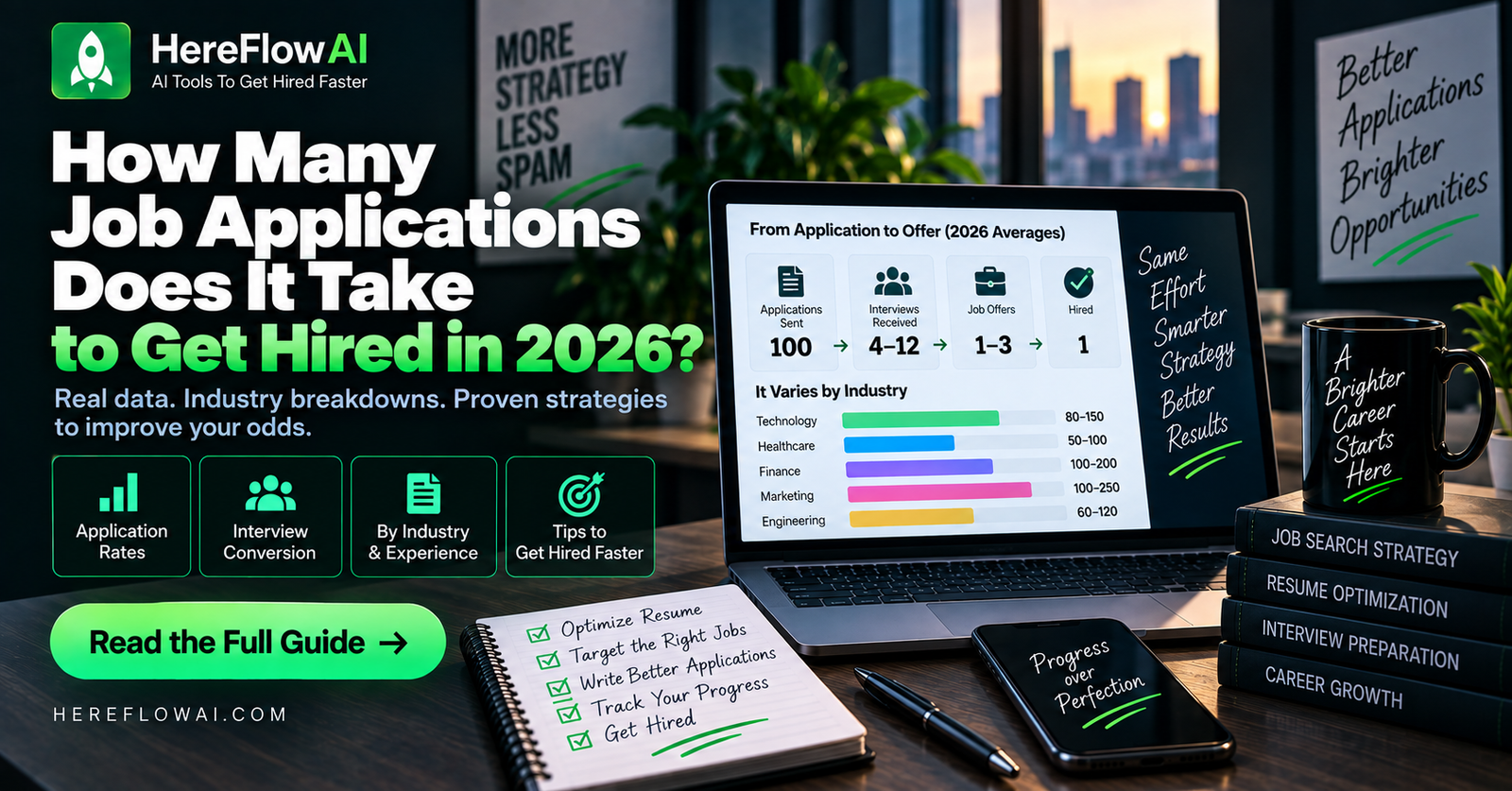

How Many Job Applications Does It Take to Get a Job in 2026?
Sending 100 applications does not guarantee a job.
Sending five highly targeted applications does not guarantee one either.
So how many job applications does it actually take to get hired in 2026?
A national 2026 survey of 1,000 current and recent U.S. job seekers found that people submitted an average of 62.6 applications during their search and received about 4.76 interviews.
But the number changed dramatically by industry.
Technology job seekers reported an average of 103.7 applications, while healthcare workers reported 41.6 and education workers 35.7.
That gives us a useful benchmark, but not a target.
You should not decide:
“I need to send exactly 63 applications.”
The better question is:
How many applications should I send before the results tell me something needs to change?
That is what matters.
Table of Contents
The Short Answer
For many job seekers, finding a job can require dozens of applications.
Current 2026 survey data suggests:
- Average job seeker: 62.6 applications
- Tech: 103.7 applications
- Gen Z: 75.8 applications
- Laid-off workers: 95.3 applications
- Healthcare: 41.6 applications
- Education: 35.7 applications
But application count alone is a bad success metric.
Someone sending 30 targeted applications and getting five interviews has a healthier search than someone sending 200 generic applications and getting none.
Track conversion, not just volume.
Why It Takes So Many Applications in 2026
Competition has increased significantly.
Greenhouse analyzed more than 640 million applications across 6,000+ companies and found that average applications per job increased from 116 in 2022 to 244 in 2025.
That is a 111% increase in only three years.
At the same time, the average number of recruiters per organization in Greenhouse’s dataset fell sharply.
More applicants.
Fewer recruiters.
More automated screening.
That creates a simple problem:
Applying is easier than getting noticed.
Sending more applications can help—but only until quality starts falling.
How Many Jobs Should You Apply to Per Day?
There is no ideal number that works for everyone.
A practical target for an active job seeker is usually:
3–5 strong applications per day.
That gives you enough volume to build a pipeline without forcing you to submit the same generic resume everywhere.
If the jobs are complex and require significant tailoring, even 2–3 strong applications may be enough.
If you are applying for high-volume roles such as retail, warehouse, customer service or hospitality, you may reasonably apply to more.
The number matters less than whether each application is credible.
Before clicking Apply, you should be able to answer:
- Do I meet most important requirements?
- Is my resume relevant to this role?
- Is the vacancy still active?
- Can I explain why I am a realistic candidate?
- Have I already applied to this company?
If the answer is repeatedly no, increasing volume will mostly increase rejection.
How Many Jobs Should You Apply to Per Week?
For most active job seekers, 15–25 well-targeted applications per week is a reasonable starting point.
That is enough volume to learn from your results.
After a few weeks, stop guessing and look at the numbers.
If applications are producing interviews, keep going.
If they are producing nothing, fix the process before doubling the volume.
The 20-Application Checkpoint
You do not need to wait until application #100 to discover your strategy is broken.
Use the first 20 strong applications as an early checkpoint.
If you sent 20 applications to jobs where you genuinely meet the requirements and received:
Several responses or interviews
Good.
Your resume and targeting are probably working.
Keep building the pipeline.
One response
Do not panic, but review your targeting.
There may be room to improve.
Zero responses
Stop.
Do not immediately send another 50 copies of the same application.
Review:
- resume positioning
- job fit
- keywords
- location
- salary expectations
- experience requirements
- ATS readability
- application timing
A broken process at 20 applications usually remains broken at 100.
Mass Applying vs Targeted Applying
Mass applying feels productive because the number goes up quickly.
But activity and progress are not the same thing.
United Way NCA found that job seekers spent an average of about 44 minutes per application and more than 46 hours in total applying during their search.
That time should not be wasted on positions you have almost no chance of getting.
The strongest approach sits between two extremes.
Do not spend three hours perfecting every single application.
But do not send the exact same resume to 100 unrelated jobs either.
Use a job-family strategy.
For example:
Software engineer roles → Resume A
Data analyst roles → Resume B
Project-management roles → Resume C
Then make smaller changes for individual jobs.
That gives you both speed and relevance.
Stop Counting Applications. Track the Funnel.
Your job search has stages:
Applications → Responses → Interviews → Final Interviews → Offers
Each stage tells you something different.
If you are sending applications but getting no interviews, the problem is probably near the top of the funnel.
If you are regularly getting interviews but no offers, sending more applications does not solve your real problem.
You need to know where candidates are dropping out.
That is why tracking your search matters more than hitting an arbitrary daily application target.
Turn Your Job Search Into a System
Random applications create random results.
The HereFlowAI Smart Job Search System is designed to help you organize your search, track applications and follow-ups, identify where your funnel is failing, and focus your time on opportunities that actually deserve it.
Instead of asking:
“Did I apply enough today?”
you can start asking:
“Which part of my job search needs to improve?”
That is a much more valuable question.
JOB SEARCH
SYSTEM
Interviews · Tracking
The Smart Job Search System
This article covers one part of the process. The system covers all of it — in the order that actually works.
- An ATS-ready resume template with a worked example
- Cover letters and short application messages
- 50 interview questions with model answers
- An application tracker so nothing gets lost
What If You Have Sent 50 Applications With No Interviews?
Do not keep increasing volume.
Your resume may be the bottleneck.
Start by checking whether your resume clearly matches the type of jobs you are targeting.
Look at:
- job titles
- relevant skills
- measurable achievements
- industry terminology
- formatting
- unnecessary information
Many employers now use applicant tracking and AI-assisted recruiting technology, so resumes also need to remain easy for software to understand.
Read:
If the resume itself needs rebuilding:
What If You Get Interviews but No Offers?
Your application volume is probably not the main problem.
Your resume already got you through the first filter.
Focus on interview conversion instead.
Review:
- how clearly you explain your experience
- whether your examples are specific
- your answers to behavioral questions
- salary expectations
- technical preparation
- questions you ask the employer
- how you explain why you want the role
Do not rebuild the top of the funnel when the bottom is leaking.
Is Applying to More Jobs Better?
Only when the additional applications remain relevant.
Suppose you can submit:
20 strong applications
or:
100 random applications.
The second option produces a bigger number.
It does not necessarily produce a better job search.
The 2026 market is already flooded with applications. Greenhouse’s benchmark found an average of 244 applications per job in 2025, more than double the level seen in 2022.
You do not win that competition by becoming more generic.
You win by becoming easier to evaluate.
A Better Weekly Job Search System
Use a simple cycle.
Monday
Find strong new openings.
Prioritize recently posted roles and companies you genuinely match.
Tuesday–Thursday
Submit targeted applications.
Track every application immediately.
Friday
Review the funnel.
How many applications?
How many responses?
How many interviews?
Which job family is performing best?
What should change next week?
That feedback loop is more valuable than blindly setting a goal of 20 applications every day.
How Long Should You Keep Applying?
Until you have accepted an offer.
Do not stop because:
- an interview went well
- you reached the final round
- the recruiter said they liked you
- someone said an offer was probably coming
A verbal signal is not a job.
Keep your pipeline active until the process is complete.
This also protects you from losing weeks when an employer suddenly delays, rejects or ghosts you.
Final Verdict
So, how many applications does it take to get a job?
Current 2026 survey data suggests the average U.S. job seeker submitted about 62.6 applications, while some groups required far more. Tech job seekers averaged more than 100 applications.
But there is no magic application number.
The better rule is:
Apply consistently.
Track the results.
Review your funnel after roughly 20 strong applications.
Fix the weak stage before adding more volume.
Twenty applications that teach you something are worth more than 200 applications you never analyze.
Frequently Asked Questions
How many job applications should I submit per day?
Around 3–5 targeted applications per day can be a reasonable starting point for an active search, but complex roles may require fewer and high-volume jobs may justify more.
How many jobs should I apply to per week?
Around 15–25 well-matched applications per week is a practical starting range. Adjust based on your industry and the results you are getting.
Is 100 job applications a lot?
Not necessarily. United Way NCA’s 2026 survey found tech job seekers submitted an average of 103.7 applications. What matters is whether those applications are generating interviews.
Should I mass apply to jobs?
Mass applying can increase volume but often reduces relevance. A better approach is creating tailored resume versions for specific job families and focusing most effort on jobs you realistically match.