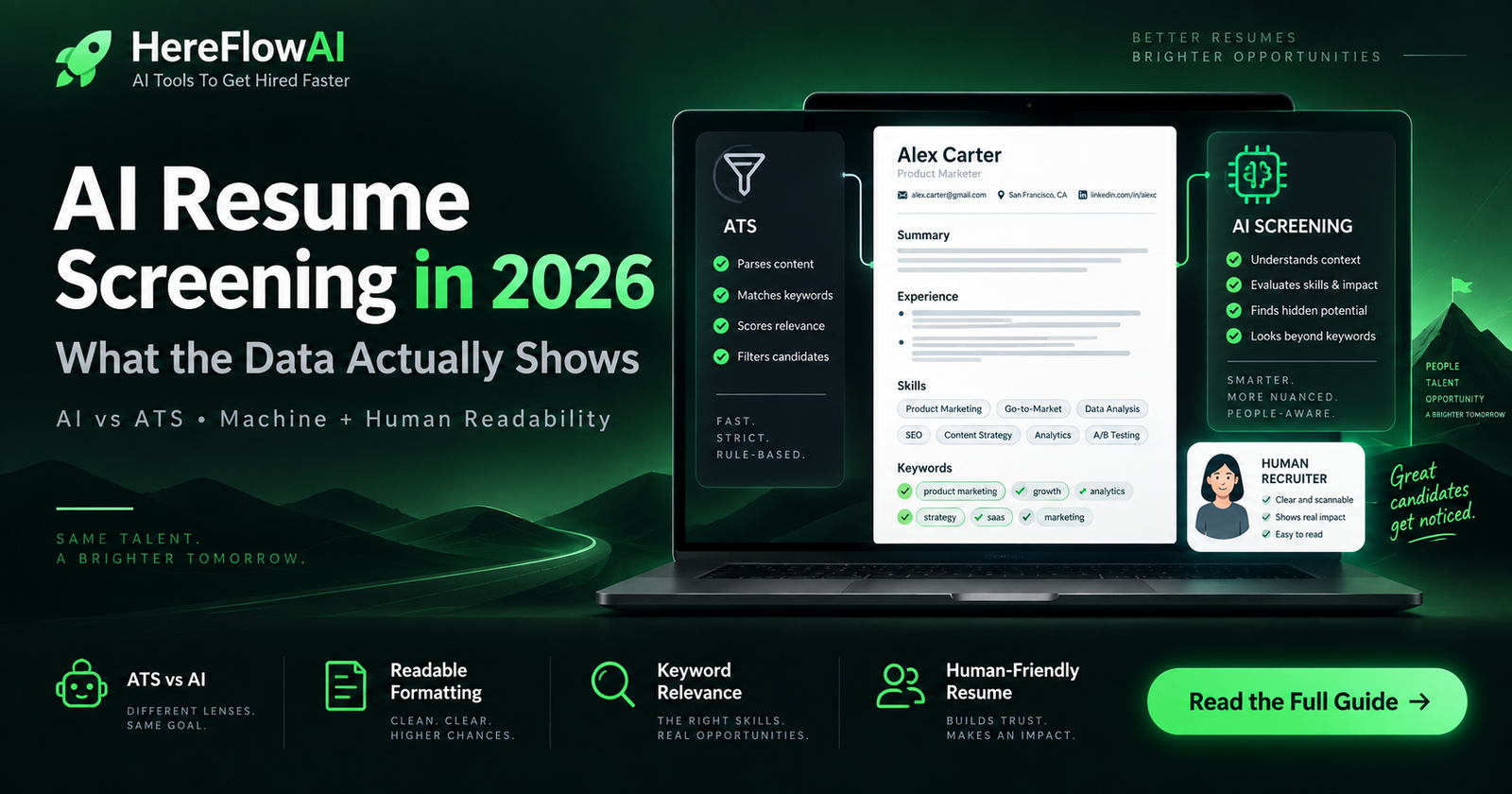

AI Resume Screening in 2026: How Employers Actually Screen Your Resume
You submit a resume.
Seconds later, software may already have parsed your experience, extracted your skills, checked basic requirements, compared your background with the job description, or summarized your application for a recruiter.
But there is an important distinction most advice online misses:
Not every ATS uses AI. Not every employer lets AI reject candidates. And there is no universal “AI resume algorithm” you can hack.
What has changed is the scale of automation.
A 2026 Resume Genius survey of 1,500 U.S. hiring professionals found that 87% use AI in at least one part of recruitment, while 58% use it to screen resumes and job applications.
That does not mean exactly 58% of every resume submitted in America is automatically judged by AI.
It means AI-assisted resume screening has moved from an edge case into a mainstream recruiting workflow.
And if you are applying for jobs in 2026, your strategy needs to reflect that.
HereFlowAI short answer: Build your resume for two readers: software needs to understand it, and a human needs to believe it.
Want a cleaner, job-targeted resume?
Table of Contents
AI Resume Screening Statistics for 2026
One reason this topic is confusing is that different studies report dramatically different percentages.
That does not necessarily mean one study is wrong.
They often ask different questions, survey different populations, and use different definitions of “AI.”
| 2026 Finding | Result | What It Means |
|---|---|---|
| Hiring professionals using AI somewhere in recruitment | 87% | AI is already mainstream across hiring workflows. |
| Using AI for resume or application screening | 58% | Resume screening is one of the most common recruiting AI use cases. |
| Hiring managers using an ATS | 71% | ATS use is widespread, but ATS does not automatically mean AI. |
| AI screening some candidates before human review | 19% | Some employers use automation before a recruiter sees the application. |
| Limited-human-review advancement or rejection | 6% | Fully autonomous decision-making remains much less common. |
| Hiring teams that fully trust AI | 41% | AI adoption is currently ahead of full employer trust. |
Resume Genius’ separate 2026 Hiring Insights survey found that 71% of hiring managers use ATS software, 79% reported some hiring automation, 35% reported AI being used to screen or rank resumes, and 19% said AI can screen out some applications before a person reviews them. Only 6% said AI could move candidates forward or reject them with limited human oversight.
HireVue’s 2026 global research adds another useful perspective: 77% of HR teams use AI regularly, but only 41% of hiring teams fully trust it.
That gap matters.
Employers are automating faster than they are learning to trust automation.
Why You See “21%,” “35%,” “43%” and “58%” for AI Resume Screening
Search this topic and you will find contradictory statistics.
For example, Resume Genius reported 58% AI resume-screening usage in one recent U.S. survey. HireVue reported 43% for resume screening in its global 2026 research. Meanwhile, a CV-Library survey conducted in March 2026 found only 21% of recruiters reporting AI use for CV screening.
The correct conclusion is not:
“Someone is lying.”
It is:
There is no single universal AI screening rate.
Employer size, country, hiring volume, industry, tool definition, survey wording and sample population all change the result.
That is why HereFlowAI will not tell you:
“Your resume has exactly a 58% chance of being screened by AI.”
The defensible conclusion is simpler:
AI-assisted screening is already common enough that every serious job seeker should prepare for it.
ATS vs AI Resume Screening: They Are Not the Same Thing
A major SEO myth is treating “ATS” and “AI” as interchangeable.
They aren’t.
An Applicant Tracking System (ATS) is primarily software used to collect, store, organize, and manage candidates.
An ATS can contain automation or AI features, but using an ATS does not automatically mean an AI model is deciding whether you get interviewed.
| Capability | Traditional ATS | AI-Assisted Screening |
|---|---|---|
| Store applications | Yes | Usually works alongside the ATS |
| Parse resume information | Common | Common |
| Knockout questions | Common | Not necessarily AI |
| Keyword search | Often rules-based | Can include contextual matching |
| Skills matching | Basic to advanced | Often AI-assisted |
| Rank or recommend candidates | Possible | Common AI use case |
| Final hiring decision | Usually no | Usually remains human-led |
This distinction matters because many job seekers waste time trying to “beat the ATS” when the real objective is much more reasonable:
Make your qualifications easy for software to extract and easy for a recruiter to verify.
How AI Resume Screening Actually Works
There is no single process used by every employer, but modern hiring workflows commonly combine several layers.
Step 1: Your application enters the hiring system
Your resume, application responses and other submitted information enter the employer’s recruiting platform.
The software may extract information such as job titles, employment dates, skills, education and certifications.
This process is often called resume parsing.
Step 2: Basic eligibility may be checked
Before advanced AI matters, simple application questions can eliminate candidates.
Examples can include authorization to work, required certifications, geographic restrictions or other clearly stated job requirements.
These checks may be simple rules rather than artificial intelligence.
Step 3: Your resume can be compared with the role
AI-assisted systems can help recruiters identify candidates whose experience, skills or professional background appear relevant to a vacancy.
The important word is relevant.
Modern matching does not always depend on exact keyword repetition.
That is why keyword stuffing is a poor strategy.
Step 4: Software may rank, recommend or summarize candidates
Some tools help recruiters prioritize large applicant pools.
Resume Genius’ 2026 data found 32% of hiring managers saying AI recommends or ranks candidates while humans retain final hiring decisions.
That distinction is crucial.
A ranking recommendation is not the same thing as autonomous rejection.
Step 5: A person reviews promising candidates
Recruiters still need evidence that what the system surfaced makes sense.
This is where resumes filled with generic AI language often weaken.
A machine may understand the keywords.
A recruiter still needs to understand what you actually accomplished.
What AI Resume Screening May Look For
Do not think of an AI screener as a magical robot searching for a secret keyword.
Think in terms of evidence matching.
If an employer needs someone with project management, Python, ISO 9001, paid media, financial modeling or Salesforce experience, your resume needs to make the relevant evidence easy to identify.
| Employer Needs | Weak Resume Signal | Stronger Signal |
|---|---|---|
| Relevant skill | Keyword listed with no evidence | Skill demonstrated inside real experience |
| Relevant experience | Job title only | Responsibility + scope + result |
| Industry terminology | Vague wording | Accurate terminology used in the vacancy |
| Achievements | “Responsible for...” | Action + measurable result |
| Required certification | Hidden inside a paragraph | Clearly labeled certification section |
| Job relevance | Same generic resume everywhere | Resume tailored around the target role |
The strongest resume is not necessarily the resume with the most keywords.
It is the resume where the employer’s requirements and your evidence overlap clearly.
The Biggest Mistake: Writing for AI Instead of Writing for Evidence
Job seekers have reacted to automated hiring by doing something predictable:
They started automating their side too.
HireVue reports that 71% of candidates now use AI for resumes, while 64% use it for cover letters.
That creates a new problem.
If everybody asks AI:
“Write me a professional resume for this job.”
hundreds of applications begin sounding almost identical.
Resume Genius found that 80% of hiring managers say they can often detect AI-written resumes, 69% say resumes feel more generic than five years ago, and 76% say AI-written resumes can make it harder to understand what a candidate actually did.
The winning strategy therefore is not:
Human vs AI.
It is:
Human evidence + AI assistance.
Use AI to improve structure, identify missing information, compare your resume with a job description and suggest clearer wording.
Do not let it invent your career.
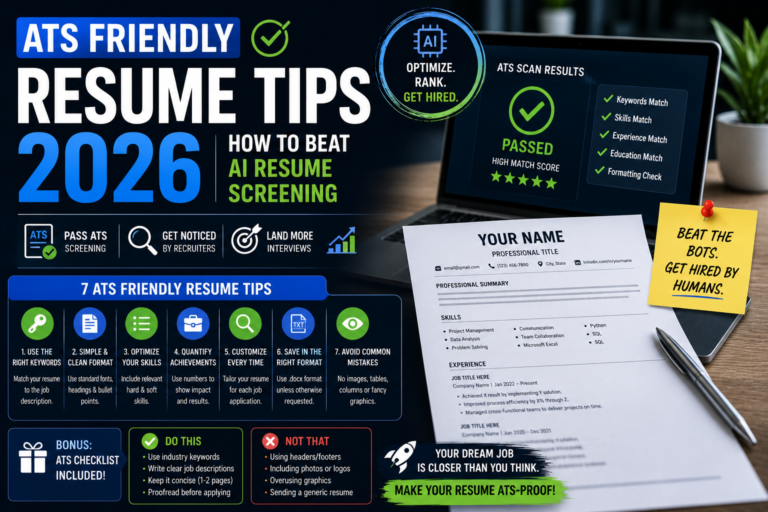
How to Optimize Your Resume for AI Screening in 2026
1. Start With the Job Description
Do not start by asking AI to rewrite everything.
Read the role first.
Identify the essential responsibilities, technical skills, tools, credentials and experience the employer explicitly requests.
Your resume should answer those requirements wherever they are genuinely supported by your experience.
2. Use the Employer’s Terminology When It Is Accurate
Suppose your resume says:
“Client relationship platform”
but the vacancy repeatedly says:
“CRM”
If you actually used CRM software, using the standard term makes your experience easier for both software and recruiters to identify.
Do not copy random keywords.
Translate your real experience into the vocabulary the employer uses.
3. Put Important Evidence Where It Belongs
A required certification should not be hidden in a paragraph.
A critical technical skill should not appear only in a generic skills cloud.
Put important qualifications in clear sections and reinforce them through your work experience where appropriate.
4. Use Standard Resume Headings
Use headings such as:
Professional Summary
Work Experience
Skills
Education
Certifications
Creativity is useful in a portfolio.
Your section labels do not need creativity.
5. Turn Duties Into Evidence
Weak:
Managed customer accounts.
Stronger:
Managed 40 active customer accounts and reduced average response time by 22%.
The second version gives both software and humans more useful information.
Never invent a percentage just to make the sentence look stronger.
6. Keep Formatting Easy to Parse
Clean formatting reduces unnecessary risk.
You do not need to assume that every two-column resume automatically fails modern ATS software—that claim is too simplistic.
But when applying through an unknown hiring system, a clear structure with readable text and conventional sections remains the safer default.
7. Humanize AI-Generated Writing
Remove filler such as:
“Dynamic results-driven professional leveraging innovative solutions to drive strategic excellence.”
Replace it with evidence.
Specific beats impressive-sounding.
8. Never Use Hidden Keywords or Prompt Injection
This advice became even more important in 2026.
Researchers from Duke University and collaborators analyzed nearly 200,000 real resumes and found hidden prompt injections in roughly 1% of them. The technique involves invisible instructions designed to manipulate AI resume-screening systems.
Do not do it.
Employers and recruiting platforms are actively learning to detect these tactics, and being caught manipulating a hiring system can destroy trust immediately.
AI Resume Screening Checklist
| Check | What Your Resume Should Do |
|---|---|
| Target Role | Clearly align with the job you are applying for |
| Keywords | Use relevant job terminology naturally and truthfully |
| Experience | Show evidence instead of generic duties |
| Achievements | Include real measurable results where available |
| Headings | Use conventional section names such as Experience, Skills and Education |
| Formatting | Remain clean, readable and easy to parse |
| AI Writing | Sound specific and human, not generic |
| Accuracy | Only claim skills and experience you actually have |
| Hidden Text | Never use hidden keywords or prompt-injection instructions |
Want help building this faster?
Resume.io can help structure your resume, generate draft content, and tailor application materials around a target role.
Or build your resume with Resume.io →
Can AI Reject Your Resume Before a Human Sees It?
Sometimes.
But the internet exaggerates how universal this is.
A 2026 Resume Genius survey found that 19% of hiring managers use AI to intentionally screen out some applications before human review, while 6% reported systems capable of advancing or rejecting applicants with limited human review.
That is meaningful.
It is not the same as:
“AI automatically rejects 80% of all resumes.”
Avoid websites repeating that type of statistic without showing a credible dataset.
In many organizations, AI acts more like a prioritization and productivity layer than an autonomous hiring manager.
Why Even Recruiters Don’t Fully Trust AI Screening
The irony of AI recruiting in 2026 is that adoption is rising faster than confidence.
HireVue found only 41% of hiring teams fully trust AI, despite widespread usage.
High-volume employer research from iCIMS and Lighthouse Research also found that only about a third of employers felt confident that resumes accurately reflected candidates’ real skills, while resume/profile screening was the area where employers reported some of AI’s strongest value.
That tension explains where hiring is going.
Employers want AI because applications are expensive to process.
But they increasingly want stronger proof after screening.
Your resume therefore needs to do two jobs:
Get understood early.
Then:
Survive human verification later.
AI Resume Checker vs Employer AI Screening
An AI resume checker analyzes your resume from the candidate side.
An employer’s AI screening system analyzes candidates from the hiring side.
They are not mirrors of each other.
A resume checker can help identify formatting problems, missing role terminology, weak bullet points or possible skill gaps.
It cannot know the employer’s exact hiring rules, recruiter preferences, internal candidate pool or final decision process.
That is why no legitimate resume checker should promise:
“Guaranteed ATS pass.”
Use resume checkers as diagnostic tools—not crystal balls.
Does Resume.io Help With AI Resume Screening?
Resume.io can help with the parts you control.
Its current AI resume tools provide writing assistance, job-description-based suggestions, skills help and resume scoring.
That can make tailoring faster.
What Resume.io cannot legitimately guarantee is that every employer’s AI or ATS will approve you.
No external resume builder controls another company’s hiring system.
HereFlowAI recommendation
Use Resume.io if your biggest problems are:
creating a clean resume quickly, organizing information, rewriting weak bullets, producing job-specific versions, or getting guidance instead of staring at a blank document.
If you already have a strong resume and only need highly specialized ATS analysis, compare dedicated resume checker tools too.
What Candidates Think AI Is Doing vs What Recruiters Report
This is one of the most interesting datasets of 2026.
CV-Library surveyed nearly 500 recruiters and more than 1,000 candidates in March.
75% of candidates believed AI was being used to screen CVs.
Only 21% of recruiters in that survey said they actually used AI for CV screening.
And 53% of candidates believed they had been rejected by AI without human review.
| 2026 Finding | Candidates | Recruiters |
|---|---|---|
| Believe/report AI is used for CV screening | 75% | 21% |
| Believe AI rejected them without human review | 53% | — |
| Less likely to apply when AI is involved | 28% | — |
This perception gap tells job seekers something important:
You usually do not know exactly what technology an employer is using.
Therefore, build a resume that works under multiple scenarios instead of trying to reverse-engineer one imaginary algorithm.
The Best Resume Strategy for 2026
The strongest strategy is surprisingly boring:
Relevant experience. Clear evidence. Clean structure. Accurate terminology. Human credibility.
AI has not eliminated the fundamentals.
It has increased the cost of being vague.
When employers receive hundreds or thousands of polished applications, generic language becomes almost worthless.
The resume that wins is not the one that sounds most “professional.”
It is the one that makes the easiest case:
This person has evidence that they can do this job.
Final Verdict
AI resume screening is no longer something job seekers can ignore.
Recent 2026 research shows widespread AI adoption across recruiting, with resume screening consistently appearing among the most common use cases. But the data also shows that human oversight remains significant and full trust in AI remains far from universal.
Your goal is therefore not to trick AI.
Your goal is to remove reasons for either software or a recruiter to misunderstand your value.
Build a resume that is easy to parse.
Tailor it around the actual role.
Use AI to improve—not invent—your experience.
Show measurable evidence.
And avoid gimmicks designed to manipulate hiring software.
Build the resume for the machine.
Prove it to the human.
Ready to improve your resume?
Try Resume.io to build and tailor a professional resume faster.
Or read our independent breakdown first:
Frequently Asked Questions
What is AI resume screening?
AI resume screening is the use of artificial-intelligence-assisted recruiting software to help parse, analyze, match, summarize, rank or prioritize job applications. The exact capabilities vary by employer and software platform.
Do companies use AI to screen resumes in 2026?
Yes. A 2026 Resume Genius survey of 1,500 U.S. hiring professionals found 87% using AI somewhere in recruitment and 58% using it for resume and application screening. Other studies report different percentages because methodologies and populations differ.
Can AI automatically reject my resume?
Some employers allow automation or AI to eliminate applications before human review, but it is not universal. One 2026 Resume Genius study found 19% reporting AI screening out some candidates before human review and only 6% reporting limited-human-review advancement or rejection.
Is ATS the same as AI?
No. An Applicant Tracking System manages applications and recruiting workflows. It may contain AI features, but ATS usage alone does not mean artificial intelligence is evaluating or rejecting resumes.
How do I optimize my resume for AI screening?
Use clear section headings, relevant job terminology, accurate skills, specific accomplishments, readable formatting and evidence that directly supports the job requirements. Avoid keyword stuffing and generic AI-generated language.
Should I use an AI resume checker?
An AI resume checker can help identify weak wording, missing keywords, formatting issues and possible job-description gaps. It cannot reproduce the exact screening process used by every employer.
Can I use AI to write my resume?
Yes, but use it as an assistant. AI is useful for brainstorming, rewriting and tailoring. Keep your accomplishments accurate and rewrite generic AI output so it reflects your real experience.
Does keyword stuffing help ATS?
No reliable evidence supports stuffing a resume with repeated keywords. Relevant terms should appear naturally and be backed by actual skills and experience.
Should I put hidden keywords in my resume?
No. Hidden keywords and hidden AI instructions can create ethical and technical problems. A 2026 large-scale study found prompt injection in roughly 1% of almost 200,000 resumes, and employers are becoming increasingly aware of the tactic.