
⚠️ Disclosure: This page contains affiliate links. If you buy through them, we may earn a commission at no extra cost to you.
Search this question and you’ll get six different answers: three months, five months, six months, 6.6 months, 19.9 weeks.
They’re all technically correct. Most of them are useless to you.
Here’s why: the median US job search is 11 weeks. The average is 24 weeks. That’s not a rounding difference — it’s a completely different reality, and which one applies to you depends on things you can control.
💡 The number that matters: half of job seekers find work in under 11 weeks. The average is dragged up by a smaller group of long searches. Your job is to make sure you’re in the first half.
Table of Contents
1. Why Every Article Gives a Different Number
Two statistics, both from BLS, both accurate, both telling opposite stories.
| Measure | 2026 Figure | What It Means |
|---|---|---|
| Median unemployment duration | ~11 weeks | Half of unemployed job seekers find work faster than this. |
| Average unemployment duration | ~24 weeks | The average is pushed higher by people experiencing long-term job searches. |
The average is a statistical artifact. A small group searching 12+ months drags the mean far above what a typical person experiences.
Where the other numbers come from
| Source | Figure | What it actually measures |
|---|---|---|
| BLS (June 2026) | 11 weeks median | Half of job seekers find work faster than this |
| BLS (2026) | 24–26 weeks average | Pulled up by long-term searchers |
| United Way NCA survey | 6.6 months | Self-reported, counts from first thinking about leaving |
| ConsumerAffairs | 19.9 wks avg / 8.7 median | Historical BLS analysis |
| The gap is more than 2×. Any article giving one number without saying median or mean is misleading you. | ||
Survey figures run longer than BLS figures because people count from when they started thinking about leaving, not from when they became unemployed.
⚠️ Ignore any article that gives you one number without saying whether it’s a median or a mean. They’re off by more than double.
2. The Real Numbers by Industry
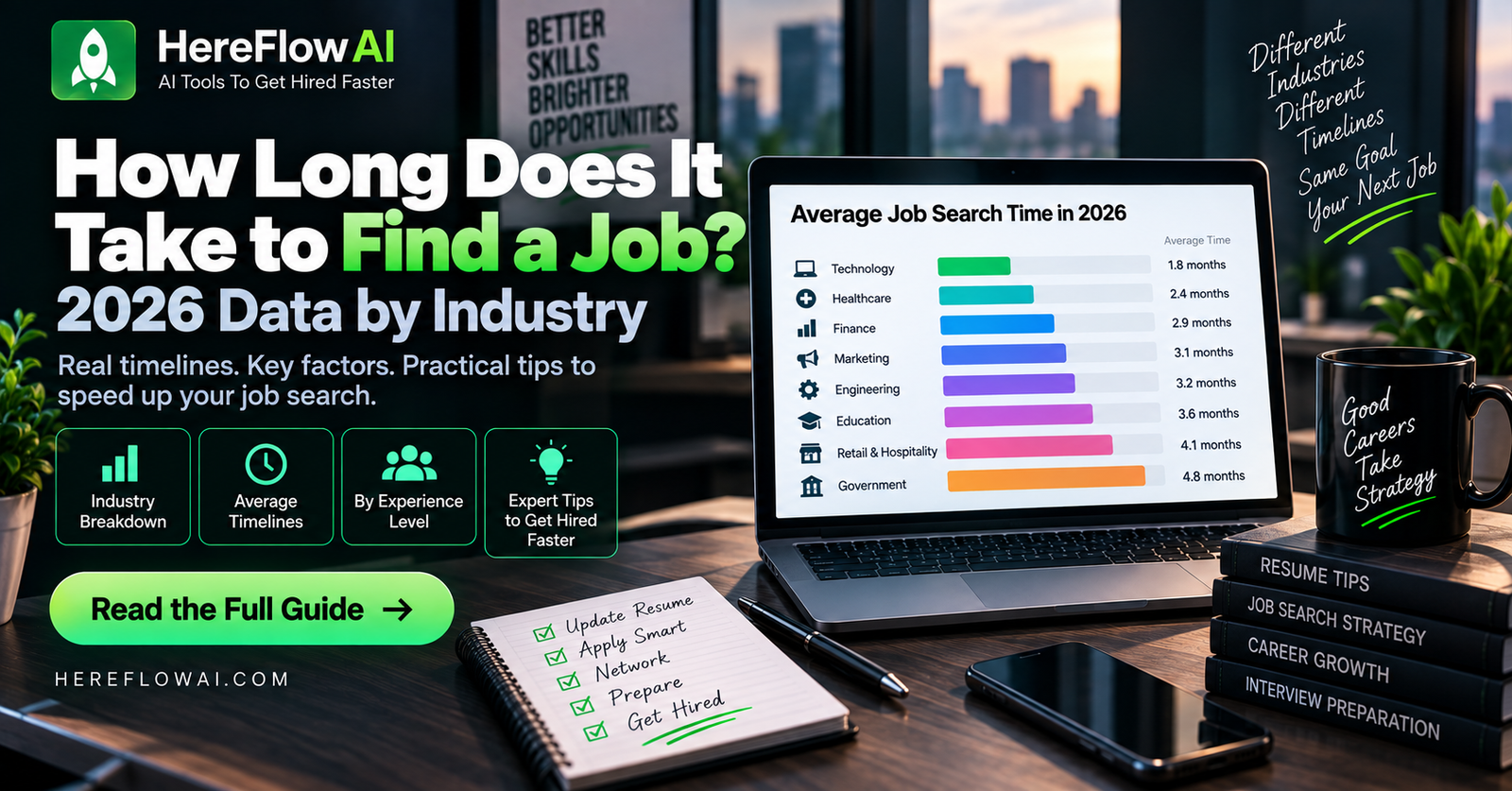
The six-month average is meaningless if your sector hires in eight weeks.
| Sector / level | Realistic timeline | Speed |
|---|---|---|
| Startups | 1–4 weeks | 🟢 Fastest |
| Hospitality, retail | 4–8 weeks | 🟢 Fast |
| Healthcare | 8–12 weeks | 🟢 Fast |
| Government | 8–16 weeks | 🟡 Average |
| Most white-collar roles | 3–6 months | 🟡 Average |
| Management / business | 12+ weeks median | 🟡 Slower |
| Tech (senior) | 6–9 months | 🔴 Slow |
| VP / C-suite | 6–9+ months | 🔴 Slowest |
3. How Many Applications It Actually Takes
This is where expectations break most badly.
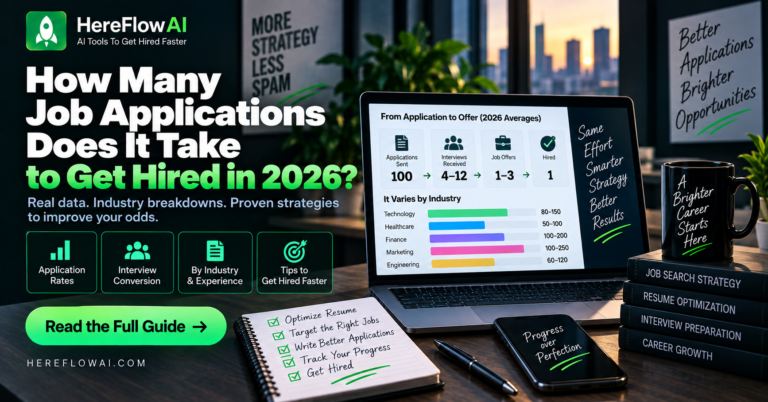
80–150 applications → 5–10 interviews → 1–2 offersBy experience level:
| Level | Applications | Interviews | Offers |
|---|---|---|---|
| Entry-level | 100+ | 5–10 | 1–2 |
| Mid-level | 60–100 | 5–10 | 1–2 |
| Senior | 30–50 | 5–10 | 1–2 |
| Tech (avg, all levels) | 103.7 | — | — |
| 75% of resumes never reach a human. Untargeted applications see a 2–5% interview rate. | |||
The conversion rates behind those numbers
- 75% of resumes are rejected by applicant tracking systems before a human sees them
- 74% of recruiters spend 20 seconds or less on a resume that gets through
- Untargeted applicants see a 2–5% interview rate — that’s 20–50 applications per interview
If you’ve sent 40 applications and heard nothing, you are not failing. You’re inside the normal range. That’s the uncomfortable truth most career advice avoids saying.
The first fix: get past the machine
Three quarters of applications die at the ATS. That’s not a content problem — it’s a formatting problem, and it’s the cheapest thing to fix.
Single column. Standard headings. No tables. No graphics. PDF.
If your resume uses a two-column layout, most parsers read straight across both columns and turn your work history into nonsense.
Full guide: How to Create an ATS-Friendly Resume →
4. The Five Things That Move Your Timeline
Not everything is in your control. These five are.
🎯 1. Targeting — the biggest lever
Candidates who target roles closely matching their skills often land offers in 2–3 months instead of six.
Untargeted searching produces a 2–5% interview rate. Targeted searching multiplies it.
⚡ 2. Application timing
Employer time-to-fill is now 42 days, up 24% since 2021 (SHRM). You can’t speed that up — but you can start more clocks at once.
Front-load your applications. Fifteen in the first two weeks all mature around week six. Fifteen spread over six weeks mature over three months.
📄 3. Resume format
75% ATS rejection rate. Fixing this costs an afternoon and removes the single biggest filter between you and a human.
🤝 4. Referrals
Referred candidates move faster and convert at higher rates than cold applicants. Three genuine conversations a week outperforms mass outreach.
📊 5. Tracking
Past 15 applications, memory fails. Without a tracker you’ll lose the thread by week three and start reapplying to companies that already rejected you — which recruiters notice.
JOB SEARCH
SYSTEM
Interviews · Tracking
The Smart Job Search System
This article covers one part of the process. The system covers all of it — in the order that actually works.
- An ATS-ready resume template with a worked example
- Cover letters and short application messages
- 50 interview questions with model answers
- An application tracker so nothing gets lost
5. How Much Savings You Need
The five-to-six-month figure has a financial consequence most guides skip.
| Your target sector | Runway to budget |
|---|---|
| Fast-hiring (retail, hospitality) | 2–3 months |
| Most white-collar roles | 4–6 months |
| Senior / executive | 8–12 months |
| 80% of job seekers report burnout · 94% have experienced ghosting (United Way NCA) | |
The United Way NCA survey found 80% of job seekers report burnout and 94% have experienced ghosting. Financial pressure is what turns a difficult search into a desperate one — and desperate searches produce worse outcomes because you accept the wrong offer.
💡 The strategic version: search while employed if you can. It’s slower and harder to manage, but you keep leverage, avoid a resume gap, and can be selective. Searching from unemployment costs you negotiating power at exactly the moment you need it.
Need income while searching? The median search runs 11 weeks. Freelancing on existing skills can generate income within 2–4 weeks, which removes the pressure that pushes people into accepting the wrong role.
6. When to Worry
There’s a difference between a slow search and a broken one.
| Where you are | Status |
|---|---|
| Weeks 1–6 | 🟢 Normal. Keep applying. |
| Weeks 6–11 | 🟢 Normal. You're at the median. |
| Weeks 12+, some interviews | 🟡 Normal for senior roles. Refine your approach. |
| Weeks 12+, few or no interviews | 🔴 The system needs fixing — volume, targeting, resume, or follow-up |
If you’re past 12 weeks with almost no interviews, more applications won’t help. The four usual causes:
- Application volume too low
- Poor targeting
- Generic resume
- Zero follow-up
Fix the system before adding effort. Sending 100 more applications with the same broken resume produces 100 more rejections.
On response times
Most companies that intend to respond do so within 1–3 weeks. Large enterprises can take four. Silence past four weeks, after one follow-up, is a no. Treat it that way and move on.
Final Verdict
The honest answer: 11 weeks if you’re at the median, 24 weeks if you’re at the average, and which one you land in is largely determined by targeting, resume format, and consistency.
Plan for four to six months of runway. Front-load your applications. Fix the ATS problem first. Track everything. Expect silence and don’t read it as a verdict on you — a 1–2% response rate is the system working as designed, not a judgment.
Most people do find work. The data says usually somewhere between month two and month five.
FAQ
How long does it take to find a job in 2026?
The median US job search runs about 11 weeks; the average is roughly 24 weeks, pulled up by long-term searchers. Most white-collar roles take 3–6 months, senior roles 6–9 months.
How many applications does it take to get a job?
Typically 80–150 applications produce 5–10 interviews and 1–2 offers. Entry-level candidates often need 100+; senior professionals may need only 30–50.
Why am I not hearing back from applications?
Roughly 75% of resumes are rejected by applicant tracking systems before a human sees them, and untargeted applications see a 2–5% interview rate. Silence is statistically normal, not a judgment.
How long should I wait before following up?
Most companies respond within 1–3 weeks. Send one follow-up at day seven. If there’s no reply after four to five weeks, treat it as a no.
Is my job search taking too long?
Under 11 weeks puts you at or ahead of the median. Past 12 weeks with few interviews suggests a system problem — targeting, resume format, or follow-up — rather than a market problem.
How much savings do I need before job searching?
Four to six months of expenses for most white-collar roles, eight to twelve for senior or executive positions. Searching while employed avoids this entirely.
Does the job search take longer in 2026 than before?
Yes, measurably. Median unemployment duration rose from 8.7 weeks in 2022 to 9.9 weeks in 2025, employer time-to-fill increased 24% since 2021, and interviews per hire rose 42%.
Read next: How to Get a Job Fast in 2026 →
Also read: Job Search Checklist 2026 →