
⚠️ Disclosure: This page contains affiliate links. If you buy through them, we may earn a commission at no extra cost to you.
Most job search checklists are one long list of 40 items with no order. You read it, feel overwhelmed, and do nothing.
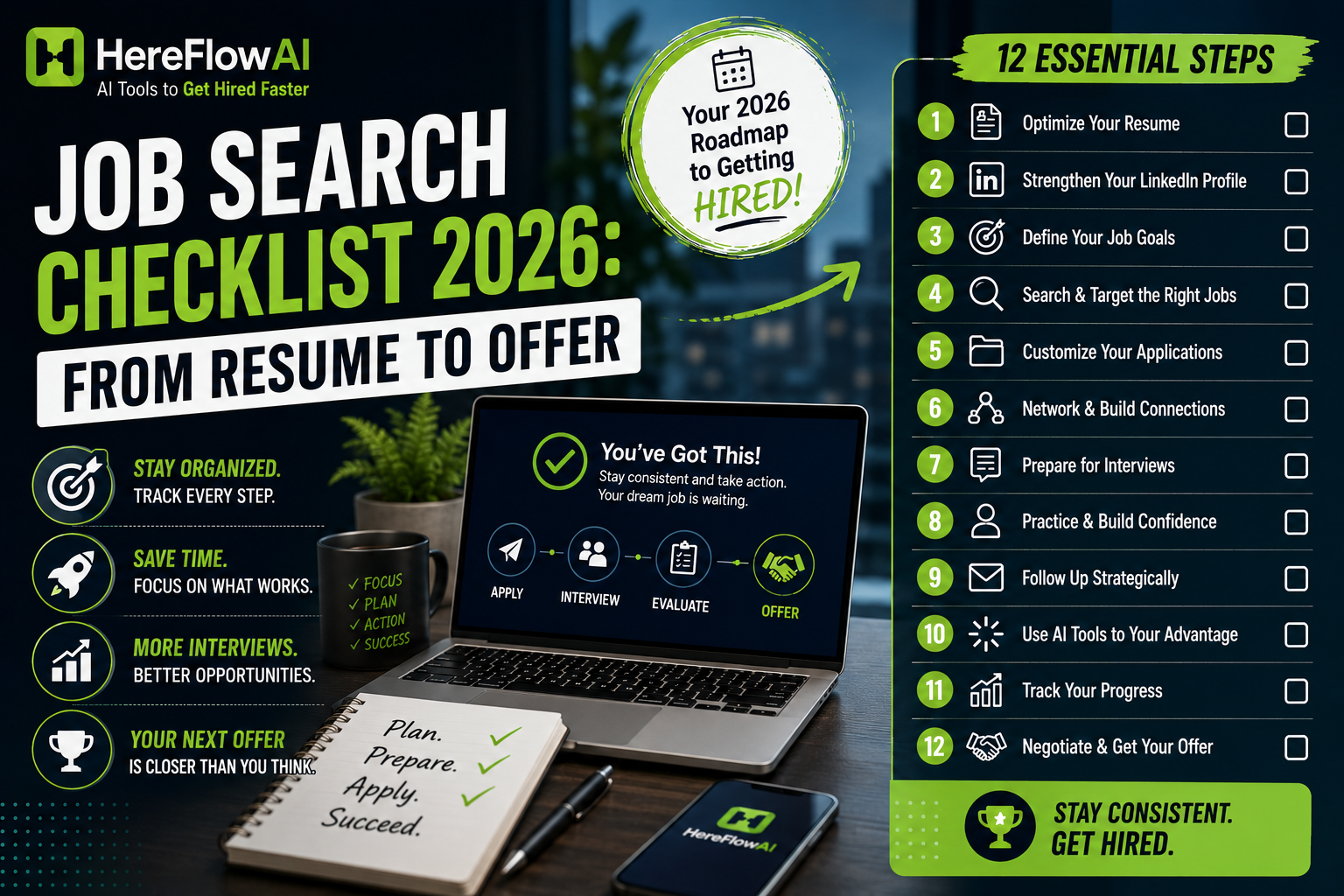
This one is split by stage — setup, applying, interviewing, closing. Work through one stage at a time. Don’t start stage 2 until stage 1 is done.
💡 HereFlowAI Tip: The point of a checklist isn’t to do everything. It’s to stop losing time to the same three or four avoidable mistakes.
Table of Contents
Stage 1 — Setup
Do this once, properly. It takes a day and saves weeks.
🎯 Direction
- Written down 2–3 target job titles
- Listed 3–5 target industries
- Defined non-negotiables (salary floor, location, work arrangement)
- Listed 15–20 target companies
📄 Resume
- Single-column layout — no tables, no sidebars
- Standard headings: Summary · Experience · Education · Skills
- Standard font, 10–12pt (Arial, Calibri, Georgia)
- No photo, no icons, no graphics
- No text inside headers or footers
- Every bullet starts with a verb
- Every number is real and explainable in an interview
- Saved as PDF, text selectable (not an image)
- Filename:
FirstName_LastName_Resume.pdf
Full guide: How to Create an ATS-Friendly Resume →
- Headline says what you do, not just your job title
- About section written in first person
- Experience matches your resume exactly
- Professional photo
- “Open to work” set (recruiters-only if you’re employed)
- Custom URL claimed
🗂️ Evidence bank
- Listed 8–10 concrete accomplishments with numbers
- Built 4–5 STAR stories: conflict · failure · leadership · problem solved · pressure
📊 Tracking
- Tracker set up (spreadsheet or tool)
- Columns: company · role · date applied · status · follow-up date · contact
Stage 2 — Per Application
Run this every single time. It takes 10–15 minutes.
Before you apply
- Read the full posting, not just the title
- Identified the 3 things they emphasise most
- Checked the company on LinkedIn (size, recent news)
- Searched company name + “scam” if it’s a remote listing you don’t recognise
Tailoring
- Rewrote your professional summary for this role
- Rewrote your top 3 bullets using their language
- Skills section reflects keywords from the posting
- No keyword stuffing — everything reads naturally
Cover letter (when required)
- Company name is correct — and isn’t from your last application
- Job title matches exactly
- Contains one specific achievement with a number
- Contains one specific, researched reason for this company
- Fits on one page
- Every placeholder bracket replaced
Full guide: Cover Letter Templates →
Submitting
- Applied within 48 hours of the posting going live
- Also applied on the company’s own careers page
- Checked whether anyone in your network works there
- Logged it in your tracker
- Set follow-up date for 7 days out
Stage 3 — Interview Prep
24 hours before
- Reread the posting — the 3 emphasised things
- Reread your own resume
- Checked the interviewer on LinkedIn
- Found one specific, recent thing about the company
- Picked which 4–5 STAR stories you’re bringing
- Prepared 3 questions to ask them
- Tested camera, mic, and link
15 minutes before
- Water within reach
- Resume and posting open
- Phone silenced, other tabs closed
- Said your “tell me about yourself” answer out loud once
During
- Pause 2 seconds before answering
- Answer the question asked, then stop
- Use a real number whenever you have one
- When you don’t know: say so, then say how you’d find out
Within 24 hours after
- Sent a short thank-you email
- Referenced one specific thing from the conversation
- Logged the outcome and next step in your tracker
- Wrote down which question caught you off guard
Full guide: Interview Preparation Pack →
Stage 4 — Offer & Closing
- Got the offer in writing before responding
- Asked for 24–48 hours to consider (this is normal)
- Researched the market range for the role and location
- Checked the full package: salary · bonus · PTO · remote policy · start date
- Prepared one counter with a researched number
- Kept other applications active until you signed
⚠️ Do not stop your search because one offer looks likely. Offers fall through. Keep the pipeline running until a contract is signed.
Weekly Rhythm
| Day | Task |
|---|---|
| Monday | Review tracker · send overdue follow-ups |
| Tuesday–Thursday | Apply to 5–8 roles, tailored |
| Friday | Reach out to 3 people |
| Weekend | Interview prep · skills gap work |
Repeat weekly. Consistency matters far more than intensity — 5 tailored applications every week beats 40 in one burst followed by nothing.
Filling Skills Gaps
If the same requirement keeps appearing in postings and you don’t have it, a short course closes the gap faster than waiting. Udemy courses drop to $9.99–$14.99 during regular sales.
Need income while you search? The median search runs about 11 weeks. Fiverr lets you earn from existing skills within 2–4 weeks, which removes the financial pressure that pushes people into accepting the wrong role.
Final Verdict
You don’t need all 60 items at once. You need Stage 1 done properly, then Stage 2 repeated consistently.
Most job searches stall for one of three reasons: the resume doesn’t parse, applications aren’t tailored, or nothing is being tracked. Everything on this list exists to prevent one of those three.
Work the stages in order. Repeat the weekly rhythm. That’s the whole method.
FAQ
What should be on a job search checklist?
Four stages: setup (resume, LinkedIn, targets, tracker), per-application steps (tailoring, submitting, logging), interview preparation, and offer handling.
How many jobs should I apply to per week?
5–8 tailored applications per week is sustainable and effective. Typically 80–150 total applications lead to one offer, so consistency over months matters more than volume in one week.
What’s the most commonly missed step?
Tracking. Past 15 applications, most people lose track of who they followed up with and start reapplying to companies that already rejected them.
Should I apply on the company website or a job board?
Both. Company career pages often route directly into the ATS, sometimes days before board applications arrive.
How soon should I follow up after applying?
Once, seven days after applying. Short and specific. If there’s no reply after another week, move on — a second follow-up rarely helps.
Should I keep applying after getting an offer?
Yes, until you’ve signed. Offers get withdrawn, and negotiating is easier when you have alternatives.
Read next: How to Get a Job Fast in 2026 →
Also read: Top Resume Mistakes That Prevent You From Getting Hired →