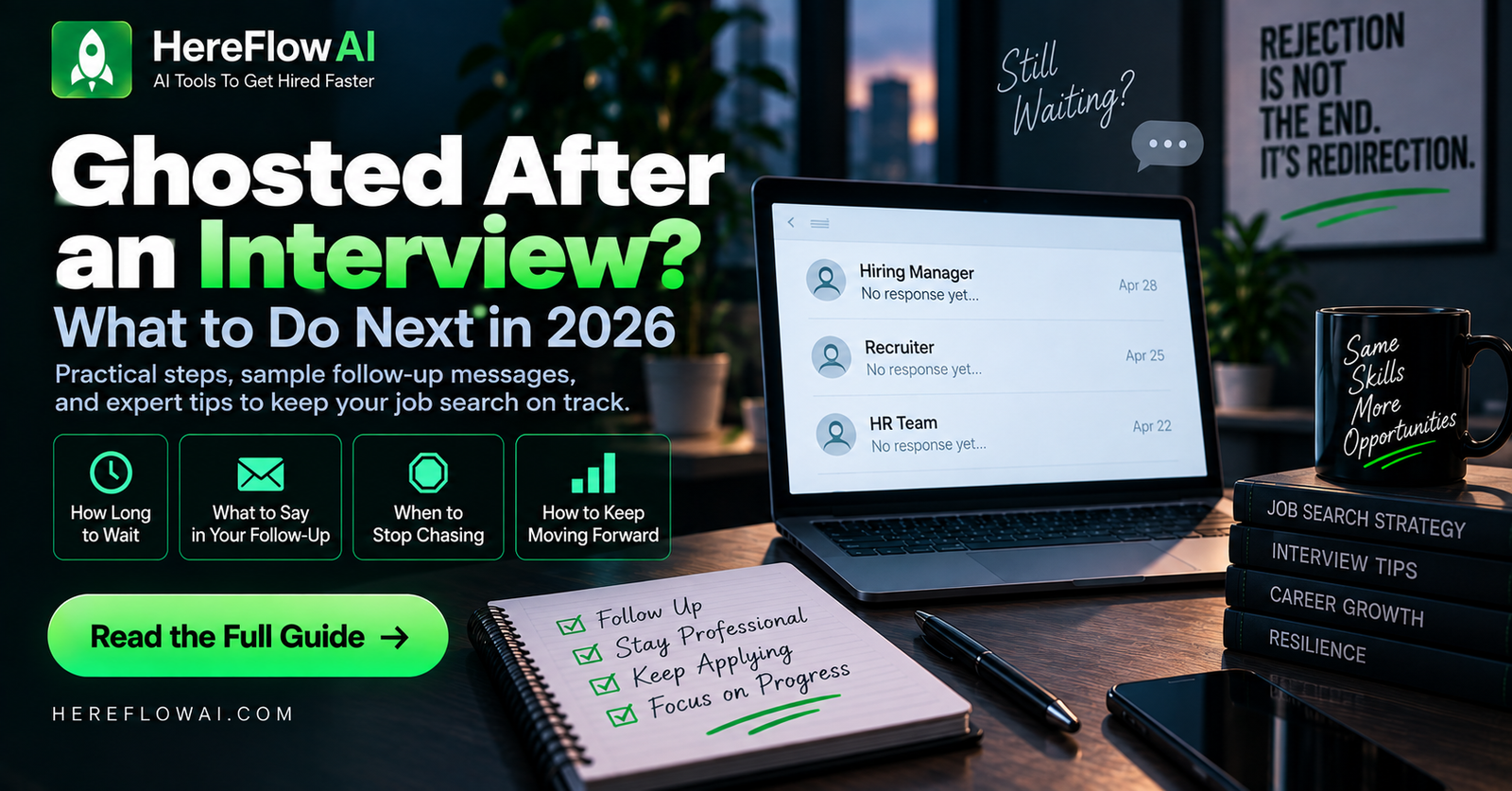

Ghosted After an Interview? Here’s What to Do Next
You finished the interview, the conversation seemed positive, and the recruiter said they would be in touch.
Then nothing.
If you have been ghosted after an interview, the most important thing is not to panic or start sending repeated messages.
Employer ghosting is common. A 2026 ResumeBuilder survey of 1,000 recent and rising U.S. college graduates found that 68% said an employer had failed to respond after a job interview.
An earlier Greenhouse survey of 2,500 workers across the U.S., UK and Germany found 61% had experienced post-interview ghosting.
Silence does not always mean you failed the interview. Hiring decisions get delayed, positions get paused, another candidate may be ahead of you, or the company may simply communicate badly.
What matters is what you do next.
Table of Contents
How Long Should You Wait After an Interview?
Start with the timeline the employer gave you.
If they said:
“We’ll have an answer by Friday.”
Do not chase them on Thursday.
If Friday passes without an update, wait until the next business day and then send a short follow-up.
If the interviewer gave you no timeline, waiting around five business days before checking in is reasonable.
The goal is to show continued interest without turning one application into your full-time job.
| Situation | When to Act | What to Do |
|---|---|---|
| Interview just finished | Within 24 hours | Send a short thank-you message |
| Employer gave a decision date | After the deadline passes | Send your first follow-up |
| No timeline was provided | Around 5 business days | Ask politely for an update |
| No reply to your follow-up | Several business days later | Send one final message |
| Still no response | After the final follow-up | Move on and keep applying |
What to Do When an Employer Ghosts You
1. Send One Professional Follow-Up
Keep it short.
Subject: Follow-Up — [Job Title] Interview
Hi [Name],
Thank you again for speaking with me about the [Job Title] position. I enjoyed learning more about the role and the team.
I remain very interested in the opportunity and wanted to check whether there are any updates regarding the next steps.
Please let me know if you need anything else from me.
Best,
[Your Name]
That is enough.
Do not write a long message explaining how disappointed you are.
Do not accuse the recruiter of ghosting you.
And do not send another message two hours later.
2. Keep Applying
This is the most important rule.
A good interview is not a job offer.
Even if the hiring manager seemed enthusiastic, keep applying until you have a confirmed offer you are comfortable accepting.
Stopping your job search every time an interview goes well can create a costly cycle:
Interview → wait two weeks → rejection or silence → restart job search.
Keep the pipeline moving instead.
3. Follow Up Once More if Necessary
If your first follow-up receives no reply, wait several more business days.
Then send one final message.
For example:
Hi [Name],
I wanted to follow up once more regarding the [Job Title] position. I’m still interested in the opportunity and would appreciate any update you can share about the hiring process.
Thanks again for your time.
[Your Name]
If that also receives no response, stop chasing.
The company can still contact you later, but you should treat the opportunity as low probability.
4. Track It and Move On
Do not keep the interview mentally “open” forever.
Record:
- interview date
- recruiter or hiring manager
- promised decision date
- first follow-up
- final follow-up
- current status
Then focus on the next opportunity.
A simple application tracker makes this much easier when you are managing several interviews at once.
Ghosted After a Second Interview?
Being ghosted after a second interview feels worse because the employer has already invested significant time in you.
But the strategy is the same.
Wait until the promised decision date.
Follow up once.
Send one final message if necessary.
Then continue your search.
A second interview means you were a serious candidate.
It does not mean an offer is guaranteed.
Ghosted After a Final Interview?
Final-round ghosting is especially frustrating.
At this stage, you may be one of only a few remaining candidates.
Still, several things can happen:
- another candidate receives the first offer
- salary approval is delayed
- references are being checked
- leadership has not approved the hire
- the role has been frozen
If the decision date passes, follow up.
If there is still no answer after your final message, keep moving.
The safest rule is simple:
No written offer means the job search continues.
When Should You Stop Waiting?
You do not need an official rejection before moving on.
A practical timeline looks like this:
Employer misses promised date → follow up.
No response → wait several business days.
Still nothing → final follow-up.
Still nothing after that → treat it as closed unless they return.
This protects your time.
It also prevents one company from controlling your entire job search.
What If This Keeps Happening?
One employer ghosting you does not tell you much.
A repeated pattern does.
If you are regularly getting interviews but rarely moving forward, look at the interview stage rather than constantly rebuilding your resume.
Possible problems include:
- vague answers
- weak examples
- poor preparation
- unclear motivation
- salary mismatch
- technical weaknesses
- weak questions at the end of the interview
Your resume already did its job if it consistently gets you interviews.
Now the bottleneck may be interview conversion.
If that is the case, targeted interview training can be more useful than another resume template.
What If You Are Not Getting Interviews at All?
That is a different problem.
If you are sending well-matched applications but almost never getting interviews, the bottleneck may happen before the interview stage.
Review:
- resume relevance
- ATS readability
- job targeting
- skills alignment
- application quality
You can start with:
And if your resume needs rebuilding:
Do not solve an interview problem with a resume tool.
And do not solve a resume problem with more applications.
Fix the stage that is actually failing.
What If the Employer Comes Back Weeks Later?
It happens.
You may suddenly receive:
“Sorry for the delay. Are you still interested?”
You do not automatically need to reject them.
Consider:
- whether they explained the delay
- how professional the rest of the process was
- whether the role is still attractive
- whether you now have stronger opportunities
- whether poor communication seems like a larger cultural issue
Ghosting is information about the employer.
Use it.
Final Verdict
If you are ghosted after an interview, do not spend weeks waiting for certainty.
Follow this process:
Wait for the agreed timeline.
Send one professional follow-up.
Send one final message if needed.
Keep applying throughout.
Move on if communication never resumes.
Ghosting is common enough that your job-search strategy should expect it.
The best protection is not sending more follow-up emails.
It is having other opportunities moving at the same time.
Frequently Asked Questions
Is no response after an interview a rejection?
Not necessarily. Hiring can be delayed by approvals, additional interviews, another candidate or changes to the role. However, prolonged silence after follow-ups should be treated as a low-probability opportunity.
How long should I wait after an interview?
Follow the employer’s stated timeline first. If none was given, around five business days is a reasonable point for your first follow-up.
Should I follow up after a second interview?
Yes. If the promised timeline has passed, send a short and professional follow-up confirming your continued interest.
How many times should I follow up?
Usually one normal follow-up and, if necessary, one final follow-up are enough.