

⚠️ Disclosure: This page contains affiliate links. If you buy through them, we may earn a commission at no extra cost to you.
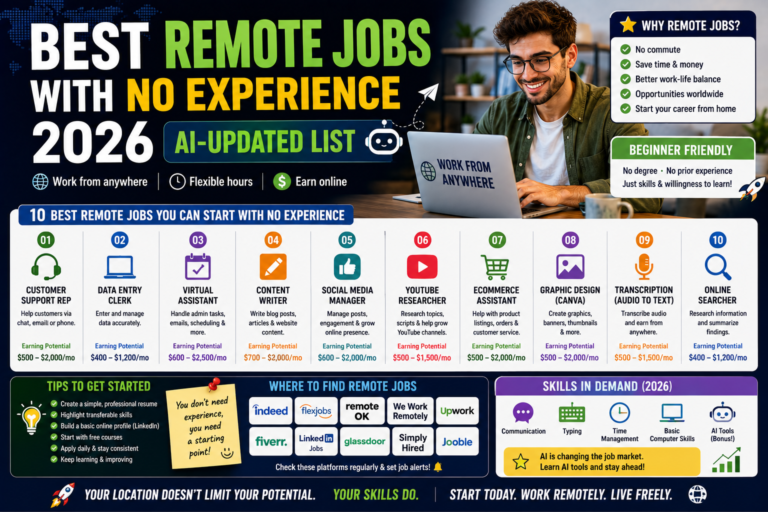
You already know the job titles. Every list gives you the same ten. What almost none of them cover is the part that actually decides whether you get hired: where to look, how to filter scams, and what to send.
This guide is the process, not the list.
💡 HereFlowAI Tip: Applicants who get hired aren’t the ones who applied to the most jobs. They’re the ones who became expert at the hiring process for one specific role type.
Table of Contents
Set Realistic Pay Expectations First
Most disappointment comes from bad expectations, not bad luck. Here’s what entry-level remote work actually pays:
| Role | Real Entry Pay | What Scam Ads Claim |
|---|---|---|
| Customer service | $15–$25/hr | "$40/hr, no experience!" |
| Data entry | $14–$25/hr | "$500/day typing!" |
| Transcription | $15–$25/hr | "$50/hr from home!" |
| Virtual assistant | $15–$30/hr | "$5,000/mo part-time!" |
| AI data annotation | $15–$30/hr | — |
The rule: if the pay is far above market for a role requiring no experience, it isn’t a job. It’s a scam or an MLM.
Realistic first-year: $22k–$28k full-time entry-level, scaling to $50k+ within 6–12 months as you specialize.
Where to Look (Ranked by Legitimacy)
Not all job boards are equal. Some screen listings; others let anything through.
🥇 Tier 1 — Screened before publication
We Work Remotely — Largest remote board with a beginner filter. Listings screened before going live.
FlexJobs — Hand-screened, no scams. Paid ($2.95 trial) — worth it if you’re applying seriously.
🥈 Tier 2 — Mostly legitimate, some filtering needed
LinkedIn Remote Jobs · Remote.co · Indeed (filter: Remote + Entry level)
🥉 Tier 3 — Apply carefully
Facebook groups · Telegram channels · Random “work from home” sites
⚠️ Never apply to a remote job posted only in a Telegram channel or Facebook group with no company website.
Direct with companies
Some employers hire remote customer service continuously: Concentrix · TTEC · LiveOps. Applying directly on their careers page skips the job-board queue entirely.
How to Spot a Scam in 10 Seconds
| 🚩 Red Flag | Why It Matters |
|---|---|
| Asks you to pay for training or equipment | Legitimate employers never charge applicants |
| Interview over WhatsApp or Telegram only | Real companies use video or phone |
| Job offer without an interview | Nobody hires blind |
| Bank details before a signed contract | Classic theft setup |
| No website or LinkedIn presence | The company doesn't exist |
| "Guaranteed income" claims | Illegal to promise in most jurisdictions |
| Asks you to receive and forward packages | This is money laundering |
One test that catches most of them: search the company name plus “scam.” Takes eight seconds.
The Application Strategy That Works
❌ What doesn’t work
Sending the same resume to 200 listings. It feels productive. It produces nothing.
✅ What works
5–10 tailored applications per week.
Step 1 — Pick ONE role type
Not five. Applying to customer service, VA, data entry, tutoring, and sales at once means every application is generic. Pick one and become good at applying for it.
Step 2 — Fix your resume for ATS
Roughly 75% of resumes are filtered by software before a human sees them. Single column. Standard headings. No tables. No graphics. PDF.
Full guide: How to Create an ATS-Friendly Resume →
Step 3 — Highlight remote-specific soft skills
This is where beginners lose. Remote hiring managers screen for: written communication, self-discipline, timezone awareness, and independence. Put these in your resume explicitly — most applicants don’t.
Step 4 — Build one piece of evidence
No experience doesn’t mean no proof. A completed course, a sample project, a small portfolio. Something a hiring manager can actually look at.
Udemy courses covering these skills drop to $9.99–$14.99 during regular sales.
Step 5 — Track every application
Where you applied, when, follow-up date. Without this you’ll lose track by week three and start reapplying to the same companies — which recruiters do notice.
Remote Interview Prep
Remote interviews test different things than in-person ones:
They will ask about:
- How you manage your time without supervision
- Your home setup and internet reliability
- How you communicate when you’re stuck
- Timezone availability
Prepare these three answers before your first interview:
- “How do you stay productive working alone?” — Give a specific system, not “I’m self-motivated.”
- “Describe your home workspace.” — Have a real answer. Dedicated space, stable connection, quiet hours.
- “How would you handle being blocked on a task?” — Show you’d communicate early, not disappear for two days.
Technical basics: test your camera and mic beforehand. A failed connection in a remote job interview reads badly.
Your 7-Day Action Plan
Day 1 — Pick one role type. Write it down. Don’t change it for 30 days.
Day 2 — Rebuild your resume for ATS. Single column, standard headings, PDF.
Day 3 — Create accounts on We Work Remotely and LinkedIn. Set up alerts for your role.
Day 4 — Build one piece of evidence: finish a short course or make a sample project.
Day 5 — Apply to 5 roles. Tailor each one — change the summary and top three bullets to match the posting.
Day 6 — Apply directly on 3 company career pages (Concentrix, TTEC, LiveOps, or similar).
Day 7 — Review. Any replies? Set follow-up dates for day 14. Plan next week’s 5 applications.
Repeat weekly. Most people who land a remote role do it in 4–12 weeks with this approach.
Protect Yourself While Job Hunting
You’ll be sending resumes containing your full name, address, and phone number — often from café or library WiFi. That traffic is readable on unsecured networks.
Final Verdict
The beginners who land remote jobs aren’t the ones who applied to the most listings. They picked one role, fixed their resume for the software that screens it, applied to 5–10 properly each week, and tracked everything.
That’s not exciting advice. It’s just the version that works.
FAQ
What work from home jobs can beginners get in 2026?
Customer service, virtual assistance, AI data annotation, transcription, and entry-level content roles all hire beginners with training provided.
How much do beginner work from home jobs pay?
$14–$30/hour depending on role. Full-time entry-level averages $22k–$28k/year, scaling to $50k+ within 6–12 months with specialization.
What’s the safest website to find legitimate remote jobs?
We Work Remotely screens listings before publication. FlexJobs hand-screens every listing but is paid. Both are far safer than open job boards.
How do I avoid work from home scams?
Never pay for training or equipment. Never give bank details before a signed contract. Avoid interviews conducted only over WhatsApp or Telegram. Search the company name plus “scam” before applying.
How long does it take to get a remote job with no experience?
Typically 4–12 weeks applying to 5–10 tailored roles per week. Blasting hundreds of generic applications usually takes longer, not less.
Do I need a degree for work from home jobs?
For most entry-level remote roles, no. Employers increasingly hire on demonstrated capability rather than credentials.
Read next: Best Remote Jobs With No Experience 2026 →
Also read: Digital Nomad Jobs for Beginners 2026 →