
Table of Contents
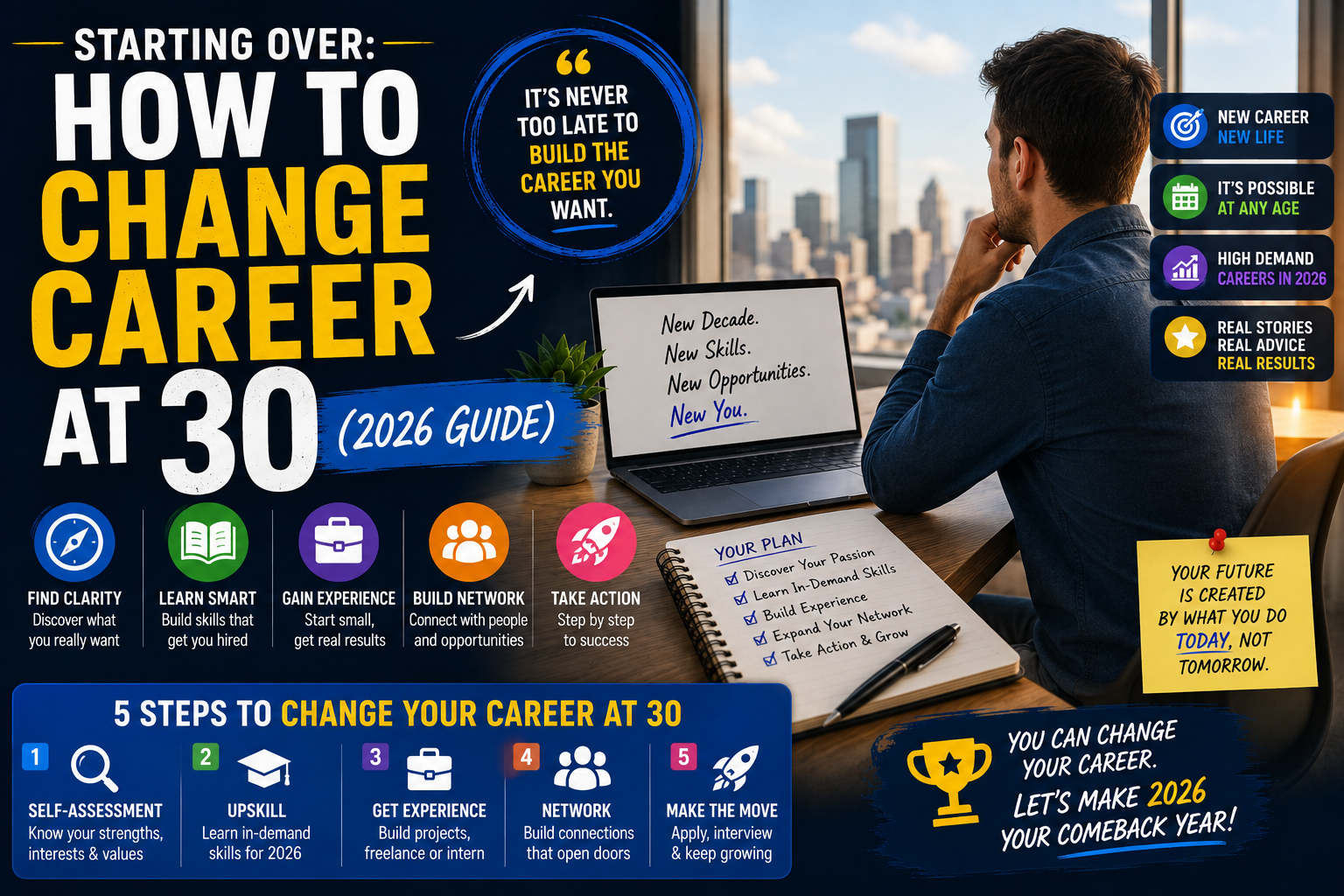
Turning 30 and feeling stuck in the wrong career is more common than most people admit. In 2026, career changes aren’t the exception — they’re the norm. If you’re starting over career at 30, you’re not behind. You’re joining millions of people who are switching industries, roles, or entire professions well into their thirties.
The idea that your twenties determine your entire career path is outdated. Thirty is often when people finally have the self-awareness, savings, and life experience to make a real, informed pivot — instead of drifting into whatever job came first after graduation.
💡 HereFlowAI Tip: The biggest mistake career changers make isn’t picking the wrong direction — it’s trying to plan the entire next 10 years before taking a single action. Pick a direction, build the skill, and apply. Clarity comes from action, not more research.
Why Starting Over at 30 Works in Your Favor
Employers hiring for entry-to-mid-level roles in a new field are often more excited about a career changer with real-world experience than a fresh graduate with none. At 30, you’re not starting from zero — you’re bringing 5-10 years of transferable skills with you.
Common reasons people start over at 30:
- Burnout in a field that no longer fits their values
- A layoff or industry disruption that forces a rethink
- Discovering a new passion through a side project or hobby
- Wanting better pay, flexibility, or remote work options
- Realizing their original degree no longer matches their interests
7 Steps to Change Career at 30
#1 — Get Honest About Why You Want to Change
Before touching a job board, answer three questions: What specifically do I dislike about my current path? What kind of work makes me lose track of time? What lifestyle do I actually want? Skipping this step is the top reason career changes fail.
#2 — Identify Transferable Skills You Already Have
List your skills from current/past jobs, hobbies and side projects, and soft skills managers have praised. This list becomes the foundation of your new resume and your talking points in interviews.
#3 — Pick a Direction (Without Overthinking It)
Popular career-change directions for people in their 30s: tech and digital skills (web development, data analysis, UX design), freelancing and remote-friendly roles, project or product management, and skilled trades or healthcare support.
#4 — Learn the Missing Skills — Without Going Back to School
You almost never need a second degree to switch careers. Online courses can get you job-ready in months, not years.
Best ways to build new skills fast:
- Structured online courses on Udemy — affordable, practical, self-paced
- Free certifications from Google, HubSpot, Meta
- Real (even unpaid) projects that give you something concrete to show employers
- Communities and forums for feedback from people already in the field
#5 — Rebuild Your Resume Around Your New Direction
This is where most career changers get stuck. Your old resume was built for your old career — it needs a full rework, not a light edit. (Full breakdown below.)
#6 — Network Into the New Field
Applying cold rarely works as well as applying warm. Reach out to people already working in your target field, ask for 15-minute chats, and be upfront that you’re changing careers.
#7 — Consider Freelancing as a Bridge
If you can’t land a full-time role right away, freelancing is a low-risk way in. Build a portfolio and real testimonials while still earning — even part-time, alongside your current job.
Paths to Change Career: Comparison
| Path | Time to First Income | Cost | Best For |
|---|---|---|---|
| Online Courses + Job Applications | 3–6 months | Low ($10–$200) | ⭐ Structure & credentials |
| Freelancing Bridge | 1–3 months | Very low | ⭐ Testing the field first |
| Networking + Direct Outreach | 2–4 months | Free | ⭐⭐ Transferable skills |
| Formal Degree/Certification | 1–2 years | High | ⭐⭐⭐ Regulated fields |
How to Write a Resume for a Career You Have No Experience In
This is where most career changers get stuck. Your old resume was built for your old career — it needs a full rework, not a light edit.
- Lead with a summary statement that explains your pivot in one or two sentences
- Reorganize bullet points to highlight transferable skills over job titles
- Cut or shrink experience that has nothing to do with your new direction
- Add a “Skills” or “Relevant Projects” section near the top
- Use keywords from target job descriptions so you pass ATS filters
Writing this kind of resume from scratch is hard to do well on your own. Many career changers use a tool like Resume.io — it offers ATS-friendly templates and guided prompts specifically designed to reframe unrelated experience into a compelling career-change story, without needing a professional resume writer.
Common Mistakes to Avoid
- Waiting for total certainty before making any move
- Applying with an unedited old resume that doesn’t speak to the new field
- Learning too much before applying instead of applying as you learn
- Comparing your timeline to younger people in the field
- Going it alone instead of using tools and communities built for this transition
Final Verdict
Starting over at 30 isn’t a setback — it’s often the first genuinely intentional career decision people make, instead of the default path they fell into after school. With a clear plan, the right skills, and a resume that actually tells your new story, a full career change is realistic within 3-6 months for most fields.
Start this week. Not next month.
FAQ
Is 30 too old to start a new career?
No. Thirty is a common and realistic age to change careers, and many employers value the experience and maturity career changers bring.
How long does it take to change careers at 30?
Most people see real progress within 3-6 months when combining focused skill-building with a targeted job search, though this varies by industry.
Do I need a degree to change careers?
Not for most fields. Online courses and certifications are often enough, except for regulated professions like law, medicine, or accounting.
How do I write a resume for a career I have no experience in?
Focus on transferable skills, reframe past experience around relevant achievements, and use a resume tool built for career changers, such as Resume.io.
What are the best skills to learn for a career change in 2026?
In-demand options include data analysis, digital marketing, UX/UI design, project management, and AI tool proficiency — all learnable through platforms like Udemy.
Should I quit my job before changing careers?
Generally no. It’s safer to build new skills, freelance, or network while still employed, then transition once income is lined up in the new field.
Read next: How to Write a Resume Using AI 2026 →
Also read: Best Udemy Courses for Job Seekers →