
⚠️ Disclosure: This page contains affiliate links. If you buy through them, we may earn a commission at no extra cost to you.
Every guide on this topic promises speed. Almost none of them tell you what the data says: the median US job search in 2026 is about 11 weeks, and the average is closer to 24.
That gap matters more than any tip. It means half of job seekers finish in under 3 months — and a smaller group takes 6 months or longer, dragging the average up.
This guide is about staying in the first group.
💡 HereFlowAI Tip: “Fast” doesn’t mean two weeks. It means finishing in 8–11 weeks instead of 24. The difference between those two outcomes is almost entirely process, not luck.
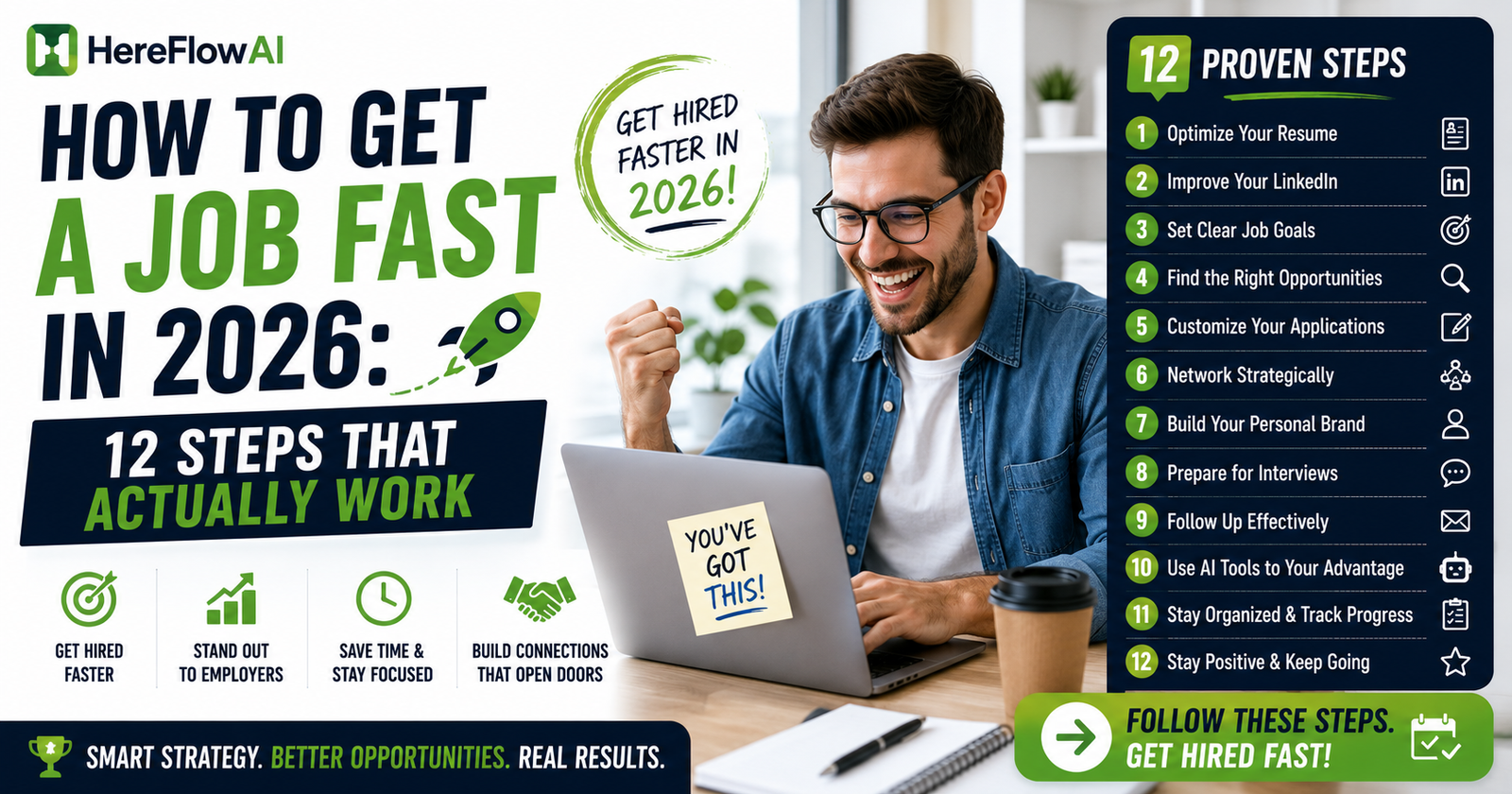
Table of Contents
What “Fast” Actually Means in 2026
Before the steps, set your expectations against real numbers:
| Measure | 2026 Reality |
|---|---|
| Median job search | ~11 weeks |
| Average job search | ~24 weeks |
| Applications to one offer | 80–150 |
| Applications → interviews | 5–10 interviews |
| Employer time-to-hire | 35–42 days |
| Response rate per application | 0.1–2% |
| Resumes filtered by ATS | ~75% |
Read that last row again. A 1% response rate means 100 applications produce one reply. That’s not you failing — that’s the system.
“Fast” in 2026 = 6–10 weeks. Anyone promising two weeks is selling something.
The Two Bottlenecks You Can Control
Your timeline splits into two parts:
Bottleneck 1 — Your side (you control this)
Finding roles, applying, following up. This is where speed is won.
Bottleneck 2 — Their side (you don’t control this)
Employer time-to-hire has risen to 35–42 days, and interviews per hire are up 42%. A company can love you and still take six weeks because three people need to approve and one is on holiday.
⚠️ The strategic implication: since you can’t speed up their clock, the only way to finish faster is to run more processes in parallel. Ten applications spread over ten weeks is slow. Ten applications in week one means ten clocks running at once.
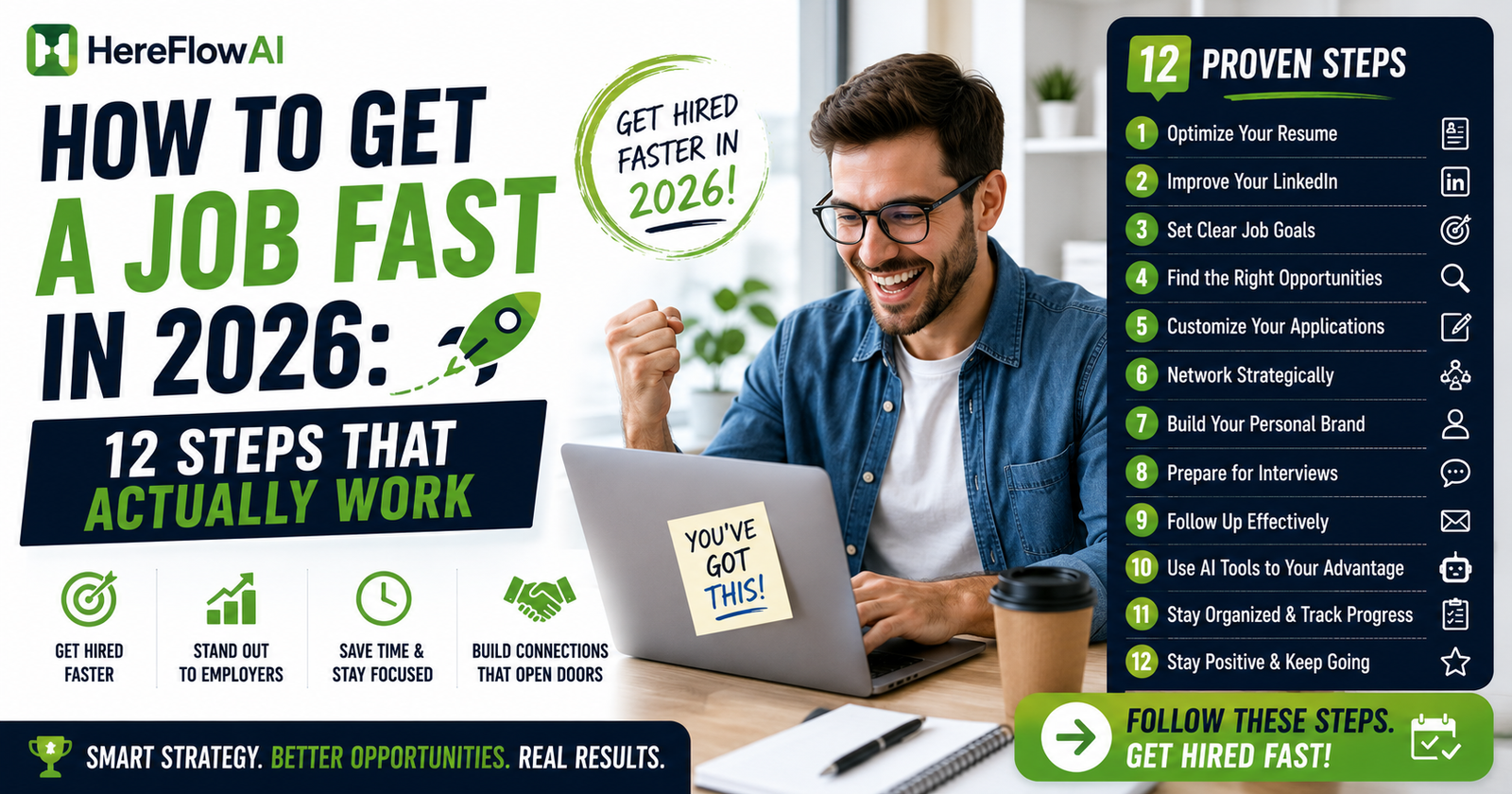
The 12 Steps
1. Pick 2–3 job titles — not “anything”
A search aimed at “anything reasonable” takes longer than one aimed at 2–3 specific titles. You can’t tailor a resume to a target you haven’t defined.
Write down: 2–3 job titles · 3–5 industries · your non-negotiables (salary floor, location, work arrangement).
2. Build your evidence list before you write anything
List 8–10 concrete accomplishments with numbers where possible: revenue influenced, time saved, people managed, problems solved.
You’ll draw from this list constantly — resume, cover letters, interview answers. Building it once saves hours later.
3. Fix your resume for ATS first
Roughly 75% of resumes are filtered by software before a human sees them. Single column. Standard headings. No tables. No graphics. PDF.
If your resume uses a two-column layout, most parsers read across both columns and scramble your experience into nonsense.
Full guide: How to Create an ATS-Friendly Resume →
4. Front-load your applications
This is the single biggest lever on speed.
Because employer clocks run 35–42 days each, applications sent in week one all mature around week six. Applications trickled out over six weeks mature over three months.
Target: 15–20 applications in your first two weeks. Not 5 per week for a month.
5. Tailor every application — but only the top third
Full tailoring takes 44 minutes on average. You can’t do that 80 times.
The 10-minute version:
- Rewrite your professional summary for this role
- Rewrite your top 3 bullets to match their language
- Leave the rest
That captures most of the benefit at a quarter of the cost.
6. Apply within 48 hours of posting
Recruiters review in batches. Early applications get seen when the pile is small and attention is high. A week later, you’re application #200.
Set alerts on LinkedIn and Indeed for your 2–3 target titles. Check daily.
7. Go direct to company career pages
Job boards add a queue. Applying on the company’s own careers page often routes you into their ATS directly — sometimes days earlier.
For any company you genuinely want, do both.
8. Use referrals — they change the math
Referred candidates move through hiring faster and convert at a significantly higher rate than cold applicants.
The ask that works:
“Hi [Name] — I’m applying for [role] at [company] and saw you work there. Would you be open to a quick chat about the team? No pressure if the timing’s bad.”
Ask about the team, not for a favour. Referrals follow conversations.
9. Contact 3 people per week
Not 30. Three, done properly:
- Someone in your target role
- Someone at a target company
- Someone from your past who knows your work
15-minute conversations, not job requests. Most roles that get filled quickly get filled through someone who knew about them early.
10. Track everything
At 15+ applications, memory fails. By week three you won’t remember who you followed up with, and you’ll reapply to companies that already rejected you — which recruiters do notice.
Track: company · role · date applied · status · follow-up date · contact.
11. Follow up once, on day 7
One follow-up email a week after applying. Short, specific, no pressure.
Send once. If nothing after another week, move on. A second follow-up rarely helps and sometimes hurts.
12. Prepare interview answers before you need them
Interviews arrive with 2–4 days’ notice. Preparing then is too late.
Build 4–5 STAR stories in advance covering: a conflict, a failure, a leadership moment, a problem you solved, working under pressure. Almost any behavioural question can be answered by adapting one.
Realistic Timeline by Situation
| Role / Situation | Typical Timeline | Speed |
|---|---|---|
| AI / ML Engineer | ~8 weeks | 🟢 Fastest |
| Customer service | ~8 weeks | 🟢 Fast |
| Sales representative | ~10 weeks | 🟢 Fast |
| Retail | ~10 weeks | 🟢 Fast |
| Nursing | ~11 weeks | 🟡 Average |
| Hospitality | ~12 weeks | 🟡 Average |
| UX / UI Designer | ~13 weeks | 🟡 Average |
| DevOps Engineer | ~14 weeks | 🟡 Slower |
| Director level | ~24 weeks | 🔴 Slowest |
Your industry matters more than most guides admit. AI/ML roles average around 8 weeks. Director-level roles average 24.
What Slows People Down Most
❌ Mass-applying without tailoring
80 generic applications underperform 20 tailored ones. Response rates on untailored applications sit near the bottom of that 0.1–2% range.
❌ Applying to one job at a time
Waiting for a reply before sending the next means one 40-day clock at a time. That’s how a 10-week search becomes 6 months.
❌ Stopping after an interview
Never pause your pipeline because one process looks promising. Keep applying until you’ve signed.
❌ Only using job boards
Many roles fill through referrals and internal moves before they’re widely seen. Boards alone means you’re only seeing part of the market.
Speeding Up the Skills Gap
If postings consistently ask for something you don’t have, a short course closes it faster than waiting. Udemy courses drop to $9.99–$14.99 during regular sales — cheap enough to be worth it for a single missing skill.
Need income while searching? The average search is 11 weeks. Fiverr lets you earn from existing skills in 2–4 weeks — which removes the financial pressure that makes people accept the wrong offer.
Final Verdict
You can’t make employers move faster. Their clock is 35–42 days and that’s fixed.
What you can do is start more clocks at once, make each application count, and keep the pipeline full until you’ve signed something.
Do that and you finish around week 8–11 instead of week 24. That’s what “fast” actually means in 2026 — and it’s entirely achievable.
FAQ
How long does it take to get a job in 2026?
The median US job search is about 11 weeks; the average is around 24 weeks because long searches pull it up. Half of job seekers finish in under 3 months.
How can I get a job fast?
Front-load applications (15–20 in the first two weeks), tailor each one briefly, apply within 48 hours of posting, and use referrals. Since employer hiring takes 35–42 days regardless, speed comes from running more processes in parallel.
How many applications does it take to get a job?
Typically 80–150 applications produce 5–10 interviews and 1–2 offers. Tailored applications significantly outperform generic ones.
Is it faster to apply on the company website or a job board?
Company career pages often route directly into the ATS, sometimes days earlier than board applications. For roles you genuinely want, do both.
Why am I getting no responses to applications?
Most online applications see a 0.1–2% response rate. Combined with ATS filtering — roughly 75% of resumes never reach a human — silence is normal, not a signal about you.
Does networking really speed up a job search?
Yes. Referred candidates move faster and convert at higher rates than cold applicants. Three genuine conversations per week outperform mass outreach.
Read next: How to Create an ATS-Friendly Resume →
Also read: Top Resume Mistakes That Prevent You From Getting Hired →