
Quick answer: the most useful AI agents for small business are narrow, tool-connected systems that handle a recurring job, use only the data they need, and hand risky decisions back to a person. The goal is not “maximum autonomy.” The goal is reliable follow-through without creating a new supervision problem.
That distinction matters in 2026 because “AI agent” is being used for everything from a chatbot with a calendar connection to a system that can read inboxes, update CRMs, research accounts, prepare reports, and trigger workflows. Small teams do not need the broadest agent. They need the smallest agent that can finish a valuable job safely.
Small Business AI Agents: Start With Human Approval
Before deploying an AI agent for sales, support or operations, specify its permitted actions, approved data sources, confidence thresholds and escalation path. A demo that answers easy questions is not proof that the workflow is safe to run unattended.
Start with a narrow pilot: one trigger, one measurable outcome, logging and a human approval step for messages that could cost money or expose private data. Measure time saved against model/API, setup and maintenance cost. See our automation readiness checklist and AI automation audit guide.
What counts as an AI agent for a small business?
A practical business agent has five parts: a goal, trusted inputs, tool access, decision rules, and a handoff path. It can interpret unstructured information and choose the next step inside a defined workflow. That is different from a normal chatbot, which mainly responds to prompts, and from deterministic automation, which follows fixed rules.
A useful rule is this: if a normal rule can solve the step reliably, use the rule. Add AI where language, classification, summarization, research, or drafting creates real value. Keep irreversible or high-impact actions behind explicit approval.
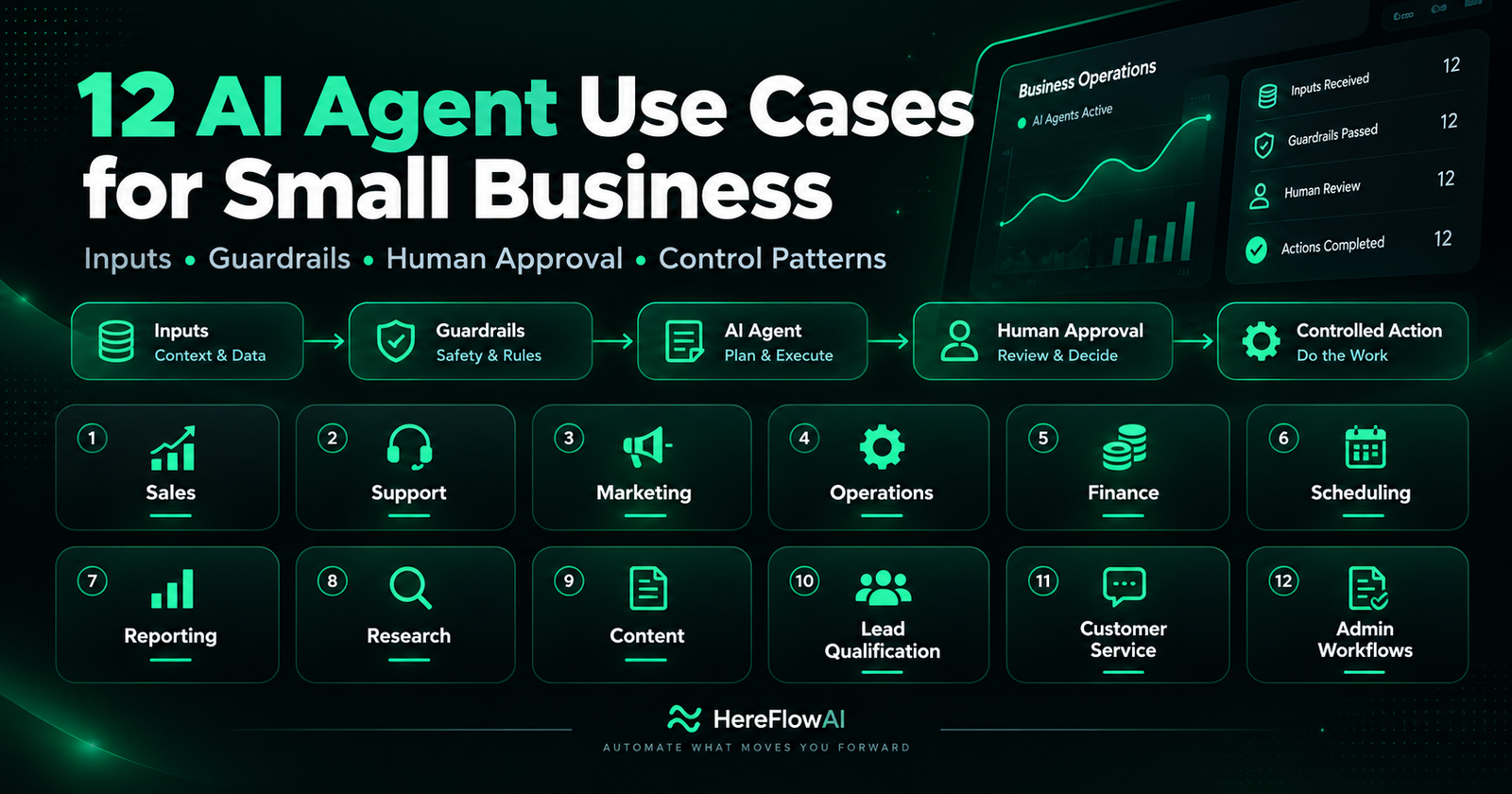
12 AI agent use cases that make sense for small teams
1. Lead intake and qualification agent
Job: read a new inquiry, extract the service requested, summarize the request, classify urgency, and prepare the record for the CRM.
Good inputs: form fields, email body, source, geography, service catalog, and clear qualification rules.
Human gate: do not let the model silently reject a lead or invent budget, authority, or urgency. Store reasons for any score so a salesperson can review them.
2. Sales meeting preparation agent
Job: combine CRM history, recent messages, account notes, and public company information into a short meeting brief.
The agent should surface facts with links or source references, not create a fictional narrative about the buyer. A good brief highlights open questions, recent activity, known priorities, and missing information.
3. Customer support triage agent
Job: classify incoming support messages, attach relevant knowledge-base context, draft a response, and route exceptions.
This works best when the agent is allowed to draft but not automatically promise refunds, policy exceptions, legal commitments, or account changes.
4. Inbox triage and drafting agent
Job: sort routine business email, summarize long threads, identify requests, and prepare replies for review.
Use a fixed taxonomy such as sales, support, vendor, finance, scheduling, and internal. The agent should return “needs review” when a message does not fit cleanly instead of forcing every email into a category.
5. Content repurposing agent
Job: turn an approved long-form source into channel-specific drafts for LinkedIn, newsletters, short posts, FAQs, or video outlines.
The source should be the approved article or transcript, not the open internet. That keeps facts and positioning consistent and makes the output auditable.
6. Review and feedback mining agent
Job: group reviews, survey responses, or support comments into recurring themes and extract representative evidence.
The useful output is not “customers are unhappy.” It is a ranked list of themes tied to actual examples, frequency, product area, and owner.
7. Market and competitor research agent
Job: monitor a defined set of sources, summarize changes, and flag what deserves human attention.
Research agents are strongest when the source list and questions are explicit. They are weakest when told to “research everything” and then present unsourced conclusions.
8. Weekly KPI reporting agent
Job: pull approved metrics from sales, marketing, support, and operations systems, then explain notable changes.
Let deterministic logic calculate the numbers. Use AI to summarize the story around them. The model should not be the calculator of record.
9. SOP and knowledge assistant
Job: answer internal process questions from approved SOPs, policies, and product documentation.
A good knowledge agent should show which source it used and say when the answer is not covered. “I don’t know” is safer than a plausible invented process.
10. Invoice and expense preparation agent
Job: extract fields from receipts or invoices, flag missing information, and prepare a bookkeeping queue.
Keep payment approval, bank actions, tax treatment, and final accounting decisions with authorized people and your accounting system.
11. Project status and risk agent
Job: read project updates, identify overdue items, summarize blockers, and create a review list for the project owner.
Do not let the agent quietly change due dates or ownership. Its job is to surface exceptions and evidence, not hide them.
12. Hiring administration and candidate brief agent
Job: organize applications, summarize job-relevant evidence, schedule steps, and prepare structured interview material.
Keep sensitive traits, final hiring decisions, and unsupported personality judgments out of the model. The safest role is administrative support and evidence organization.
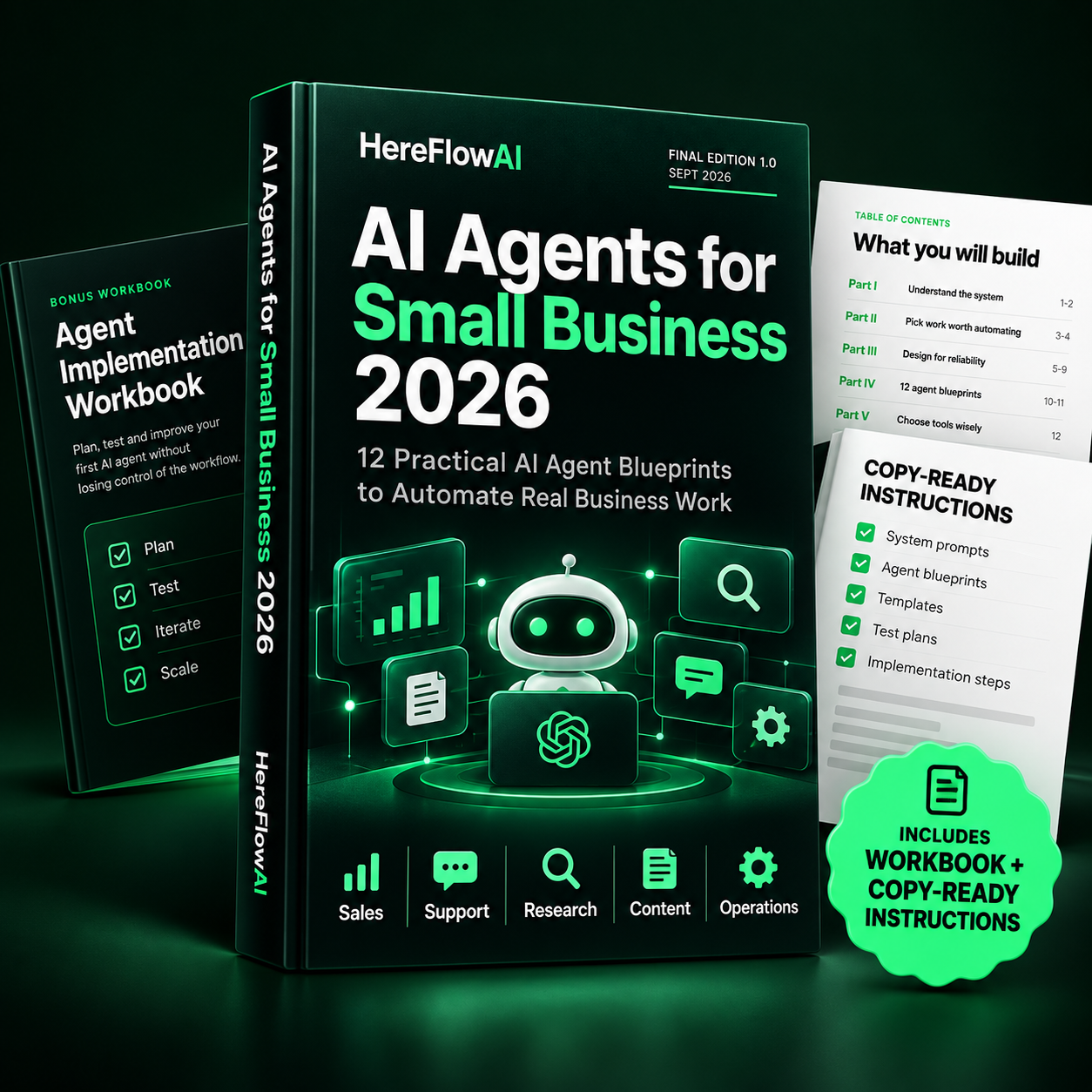
AI Agents for Small Business 2026
Go from ideas to controlled implementation with 12 practical AI agent blueprints built for real small-business work.
$14.99
LAUNCH PRICE
The pattern behind the useful agents
These use cases look different, but the production pattern is almost identical:
- One recurring job: the agent has a narrow outcome, not a vague mission.
- One source of truth: customer, project, invoice, or support status lives in a named system.
- Minimum permissions: the agent can access only the data and actions required for that job.
- Structured output: important fields return in a predictable schema, not an unstructured paragraph.
- Human escalation: uncertainty, money, legal commitments, account access, safety, or irreversible changes go to a person.
- Execution evidence: keep source links, run IDs, timestamps, reasons, and the final resolution.
What should stay as normal automation?
Do not use an AI agent to decide simple facts. Dates, thresholds, totals, exact statuses, ownership rules, opt-out flags, duplicate checks, and explicit approvals are better handled with deterministic logic. A small business gets more reliability by combining rules and AI than by replacing every rule with a model.
For example, an agent can read a lead’s message and classify its intent. A normal rule can verify whether the location is serviceable. A salesperson can approve a high-value proposal. Each layer does the job it is best at.
A simple risk test before giving an agent tool access
Ask five questions before connecting an agent to email, CRM, finance, project, or customer systems:
- What is the worst realistic action it could take with these permissions?
- Can the action be reversed?
- Can we see exactly what happened after the fact?
- What happens when data is missing, stale, or contradictory?
- Which decisions must always require an authorized person?
NIST’s AI Risk Management Framework is designed to help organizations manage AI risks across design, deployment, use, and evaluation. For a small business, the practical translation is straightforward: define ownership, limit authority, test failures, preserve evidence, and review the system as the business changes.
How to choose your first AI agent
Pick a task that is frequent, digitally observable, language-heavy, reviewable, and reversible. Avoid starting with the most impressive idea. Start with the workflow where success and failure are easy to see.
A good first pilot might be support triage, meeting preparation, lead intake, content repurposing, or internal knowledge lookup. A poor first pilot is anything that moves money, changes permissions, sends sensitive legal messages, or makes decisions that are difficult to undo.
Related HereFlowAI guides
If you are still deciding whether you need an agent or a normal workflow, read AI Agents for Business: Agent vs Chatbot vs Automation. If you are ready to build, continue with How to Build an AI Agent for a Small Business. For the broader automation layer, see Automation for Small Business in 2026.
Sources and verification
- NIST AI Risk Management Framework — risk-management framework for AI systems.
- NIST Generative AI Profile — companion guidance for generative AI risks.
FAQ
What is the best AI agent for a small business?
The best agent is the one attached to a specific recurring job with clear inputs, permissions, review rules, and a measurable outcome. “Best” depends more on the workflow than the brand.
Can AI agents replace employees?
For most small businesses, the safer and more useful model is task-level assistance: agents prepare, classify, summarize, research, and coordinate while people keep judgment and high-impact decisions.
Do I need developers to build an AI agent?
Not always. Many narrow workflows can be piloted with no-code automation, existing SaaS tools, and an AI step. More complex permissions, custom APIs, high volume, or sensitive systems may justify developer help.
What is the difference between an AI agent and workflow automation?
Workflow automation follows explicit steps and conditions. An AI agent can interpret unstructured information and choose among allowed next actions. Strong systems often use both.
| Use case | AI job | Keep deterministic | Human gate |
|---|---|---|---|
| Lead intake | Intent / urgency | Service area, dedupe | Commercial decision |
| Support | Classify / draft | Entitlements, account state | Refund / exception |
| KPI report | Explain changes | Metric calculation | Action priority |
| Finance intake | Extract / flag | Totals / IDs / status | Payment / tax judgment |
AI Agents for Small Business 2026
Go from ideas to controlled implementation with 12 practical AI agent blueprints built for real small-business work.
$14.99
LAUNCH PRICE