

Updated October 13, 2026. This independent buyer’s guide compares published vendor prices and workflow capabilities, not claims of first-hand testing. Prices may change. Every calculation below states its assumptions.
Quick verdict: An AI receptionist typically makes more economic sense for repetitive calls, appointment intake, after-hours messages and predictable routing. A human answering service can justify a higher bill when calls require judgment, empathy, nuanced sales conversations or sensitive customer support. Many small businesses are best served by AI-first answering with an explicit human escalation path.
Unlike a generic “best AI tools” list, this comparison focuses on the decision a business owner must actually make: what will callers need, how many calls must be answered, and how does each provider charge? Below we compare per-call, per-caller and per-minute pricing with concrete examples from providers’ official pages.
AI receptionist vs answering service: the differences in one table
| Question | AI receptionist | Human answering service |
|---|---|---|
| Who speaks to callers? | Software-powered voice agent | Live remote receptionist |
| Typical role | FAQs, intake, scheduling, routing | Intake, personalized conversations, nuanced escalation |
| Billing units | Per call, per caller, per minute, or plan | Often per receptionist minute or call |
| Availability | 24/7 on applicable plans | 24/7 where the plan includes it |
| Major limitation | Can misunderstand, make mistakes or fail on edge cases | More expensive; capacity and scripts may vary by provider |
| Practical choice | High-volume standardized questions | Complex, relationship-sensitive calls |
“AI” versus “answering service” can be confusing because some answering-service vendors themselves offer AI plans. In this guide, human answering service means a service where a person answers incoming calls. A hybrid model uses AI for the first interaction and transfers selected calls to people.
Real 2026 pricing: AI vs human phone answering
Important: These prices have different usage units. A $79 package with 100 unique customers is not automatically cheaper than a $59.95 package with 90 calls; a customer who calls twice counts differently. Compare your own activity pattern, not just the starting price.
| Provider and model | Published entry price | Included usage | What to check |
|---|---|---|---|
| Upfirst — AI | $24.95/month | 30 calls; $1.50 extra call | Expected number of billable calls |
| Goodcall — AI | $79/month | 100 unique customers; $0.79 extra unique customer | Number of different callers and agent limits |
| Smith.ai — AI | Free plan; Pro $150/month | Free: 25 calls; Pro: 75 calls | Human escalation as optional add-on; plan-specific fees |
| Retell AI — voice-agent platform | $0.07–$0.31/minute | Usage-based; configuration dependent | Phone costs, models, setup and technical maintenance |
| Ruby — human | $250/month | 50 receptionist minutes | Total receptionist minutes and overages |
| Smith.ai — human | $300/month | 30 calls | Per-call overages and optional tasks |
Primary vendor sources, reviewed October 13, 2026: Upfirst pricing, Goodcall pricing, Smith.ai AI pricing, Retell pricing, Ruby pricing and Smith.ai human receptionist pricing. Check billing periods, eligibility, additional features and local telephony before you buy.
Retell is a developer-facing voice-agent platform rather than the same kind of turnkey phone answering subscription as Upfirst. Its published per-minute cost should never be mistaken for a fully configured, supported business answering service.
Scenario: what might answering 75 calls a month cost?
Suppose you receive 75 inbound calls per month, each averaging two connected minutes. That is 150 talk minutes. Imagine the callers are all different people so a per-unique-caller plan’s allowance is easy to compare. This is an illustration, not a prediction or a guarantee of call quality.
| Service scenario | Published plan or formula | Monthly example |
|---|---|---|
| Upfirst AI | Premium, 90 calls included | $59.95 |
| Goodcall AI | Starter, 100 unique customers included | $79 |
| Smith.ai AI | Pro, 75 calls included | $150 |
| Ruby human | 200-minute plan covers 150 minutes | $720 |
| Retell AI platform | 150 minutes × $0.07–$0.31 | $10.50–$46.50 voice-minute component only |
The Ruby row uses a published plan with enough included minutes, not a claim that it is Ruby’s lowest possible bill for 150 minutes. A smaller plan plus overages could change the final figure. Retell’s illustration excludes setup, model-specific adjustments where applicable, telephony, optional features, ongoing monitoring and support. Goodcall and Upfirst use different counting rules, so the 75 distinct-caller assumption matters.
Takeaway: The advertised AI minute price can be very low, but the cheapest technology input is not necessarily the cheapest working service. Compare the full business workflow cost, including who will build it, test it and fix failed calls.
When an AI receptionist is the better choice
AI makes the strongest operational case for repeatable, well-defined tasks: business hours, locations, opening dates, common pricing questions, basic appointment requests, lead capture, message taking and after-hours coverage. A good deployment answers these from an approved knowledge base and avoids creating unsupported promises.
AI is also worth examining if you receive calls outside staffed hours or in unpredictable bursts. A software service may handle multiple simultaneous calls under the provider’s capacity limits. But check what the service does after identifying a genuinely urgent problem, a frustrated customer or a request outside its training.
Start with one reversible flow and test it before redirecting your primary number. Example: forward after-hours calls to an AI agent that answers common questions and creates a call-back task, while urgent or uncertain issues are escalated to a designated person.
When a human answering service is worth the extra cost
Human receptionists can be a better fit when callers need situational judgment, relationship management, reassurance, complicated intake or sensitive handoffs. Consider claims, financial disputes, unexpected service failures, confidential matters or the kinds of nuanced calls where a scripted answer could harm trust.
Humans can still make mistakes. A human plan’s quality depends on training, notes, workflows, staff availability, escalation scripts and what the contract promises. Review recordings when appropriate and examine whether the provider can accommodate your actual business-specific questions.
For healthcare, legal and other regulated contexts, do not treat either product category as automatically compliant. Request written documentation about privacy, retention, access controls, data handling, contractual obligations and how emergency or consequential decisions are handled.
The hybrid model: AI for routine calls, humans for exceptions
A hybrid setup does not need to be complicated. Define the safe first-line tasks and the situations that trigger human intervention:
- AI answers common questions using confirmed information.
- AI records the caller’s name, purpose, callback number and consent when relevant.
- AI schedules only when calendar permissions and availability are verified.
- AI escalates refund disputes, sensitive issues, urgent requests and callers who ask for a human.
- A person reviews summaries and fixes errors before the customer is forgotten.
Ask providers about live transfer, not just “escalation.” A vendor may offer a callback notification but not an actual warm transfer. Also establish a plan for outages, after-hours emergencies and unanswered transfers.
What to check before signing up: the buyer checklist
Use these questions in demos or trial calls instead of relying on vendor marketing:
- Real billing: Are you charged per minute, completed call, answered call, unique caller or line? What counts as spam, transferred calls and repeats?
- Overages: What happens after the included allowance? Are usage caps or hard stops available?
- Ownership: Can you keep your existing number and export customer data if you leave?
- Booking: Can the agent check the actual calendar and update or cancel a booking, not merely promise a booking?
- CRM handoff: Do lead records include call source, timestamp, notes, status and a responsible person?
- Quality: Test interruptions, accents, noise, incorrect dates, missing information and the request “put me through to a person.”
- Privacy: Know which recordings or transcripts are stored, who can access them, how long they persist and what caller notices apply.
- Aftercare: Who monitors failed calls, updates the knowledge base and responds when the calendar or CRM connector breaks?
Request an implementation checklist in writing and consider a short pilot with your real call patterns. The right provider is one whose failed-case behavior you can live with, not simply the provider with the most natural demo voice.
Already using Retell AI? Read the dedicated pricing breakdown
Retell and turnkey AI receptionists serve related but different buyer needs. If you plan to develop your own voice agent, the meaningful questions become model selection, prompt and flow design, infrastructure, phone provider, call quality testing and integrations. We are preparing a separate Retell AI Pricing 2026 guide that models 100, 500 and 1,000 minutes; it will complement—not duplicate—this business decision guide.
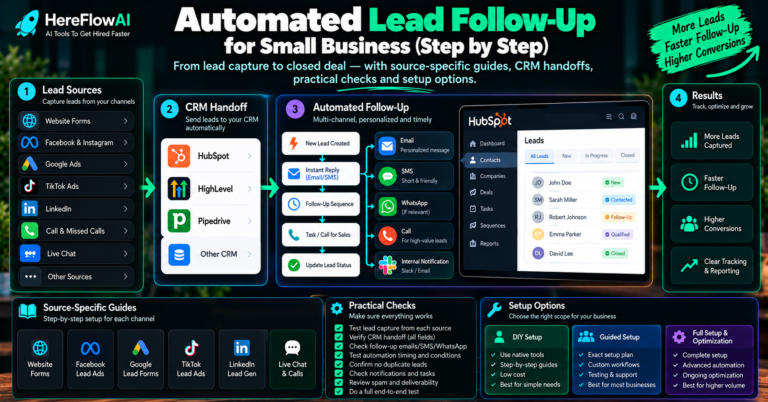
For what happens after a call, read our published small business lead follow-up automation guide and CRM follow-up automation guide.
HEREFLOWAI • PAID WORKFLOW REVIEW
Before buying an AI phone service, map the workflow.
Our $49 AI Automation Audit examines one core business workflow, identifies three priorities, and provides a process blueprint with a suggested tool stack and human approval checkpoints. Use it to plan call intake and follow-up safely. Voice AI installation, subscriptions, custom development and ongoing operation are not included in this $49 planning service.
FAQ: AI receptionist versus answering service
Is an AI receptionist the same as a virtual receptionist?
No. “Virtual receptionist” can describe either a live remote receptionist or an AI-powered voice service. Ask who answers the call and how exceptions are handled.
How much does a small business answering service cost?
There is no single price. In the official plans checked here, Upfirst AI starts at $24.95/month for 30 calls, while Ruby’s live receptionists start at $250/month for 50 minutes. Different metering units and included services make headline comparisons misleading.
Can an AI receptionist book appointments?
Some vendors advertise calendar integrations and in-call booking. Test whether the actual configuration checks available slots, handles timezone ambiguity and successfully writes the booking back to your system.
Will AI miss important calls?
It can. Failures can come from misunderstood speech, outdated business data, broken integrations, provider outages or inadequate escalation rules. Test and monitor calls instead of assuming automation is error-free.
What should a contractor, salon or agency choose?
For mostly routine inquiries and basic scheduling, trial an AI answering service with a human fallback. If most calls are sensitive, complex or relationship-driven, trial a live receptionist. Use a week of actual call logs to inform the decision.
What is the cheapest choice for 24/7 answering?
Among the specific public plans reviewed here, Upfirst lists an AI entry plan of $24.95/month for 30 calls. That does not establish that it is the cheapest provider in the entire market or that the plan covers your call volume. Compare full monthly costs and conditions.
Comparing actual service providers? See our seven-plan answering service buyer guide for pricing models, included call allowances and real monthly cost scenarios.
Final verdict: choose based on the calls, not the hype
AI receptionist: evaluate first if calls are repetitive, you need after-hours coverage and predictable intake, and someone on your team can monitor errors. Human answering service: evaluate first if most calls require nuance, empathy and judgment. Hybrid: evaluate if you want to control routine answering costs but cannot compromise on important handoffs.
The fastest way to waste money is to choose a provider based only on the lowest per-minute price. Start with call volume, complexity and failure handling, then check the complete bill. If the process is still unclear, a scoped automation audit can clarify what is worth automating.
Sources, pricing notes and editorial disclosure
Price and feature reference pages reviewed October 13, 2026: Upfirst, Goodcall, Smith.ai AI, Smith.ai human, Ruby, Retell AI. Calculations use published prices and stated assumptions. Provider prices, taxes, coverage, phone charges and overage policies can change without notice. This independent guide does not claim that HereFlowAI purchased, deployed or tested the services hands-on; provider links are direct official URLs. HereFlowAI sells the separate $49 planning audit linked above.

[…] whether software or a real receptionist is appropriate in the first place, start with our separate AI Receptionist vs Answering Service comparison. This article goes further by comparing vendors and purchasing […]
[…] Start with a subscription if you have a narrow routine task and need fast validation. Hire a specialist if your workflow requires advanced integrations and your team can manage vendor accounts. Consider managed service when long-term maintenance and human support matter. For the broader vendor-selection decision, see our AI vs human answering analysis. […]
[…] choosing a phone-answering model? Compare AI receptionists vs live human answering services, then review seven small-business answering plans for turnkey alternatives. This Retell guide is […]
[…] an in-depth general comparison of models and published supplier costs, read AI Receptionist vs Answering Service and our small-business answering service provider guide. Those articles cover general buyer […]