
Research updated October 13, 2026. This independent comparison is based on providers’ published pricing and feature documentation, not fictional hands-on tests. Check each provider’s official page before buying: plans, promotions and contract conditions can change.
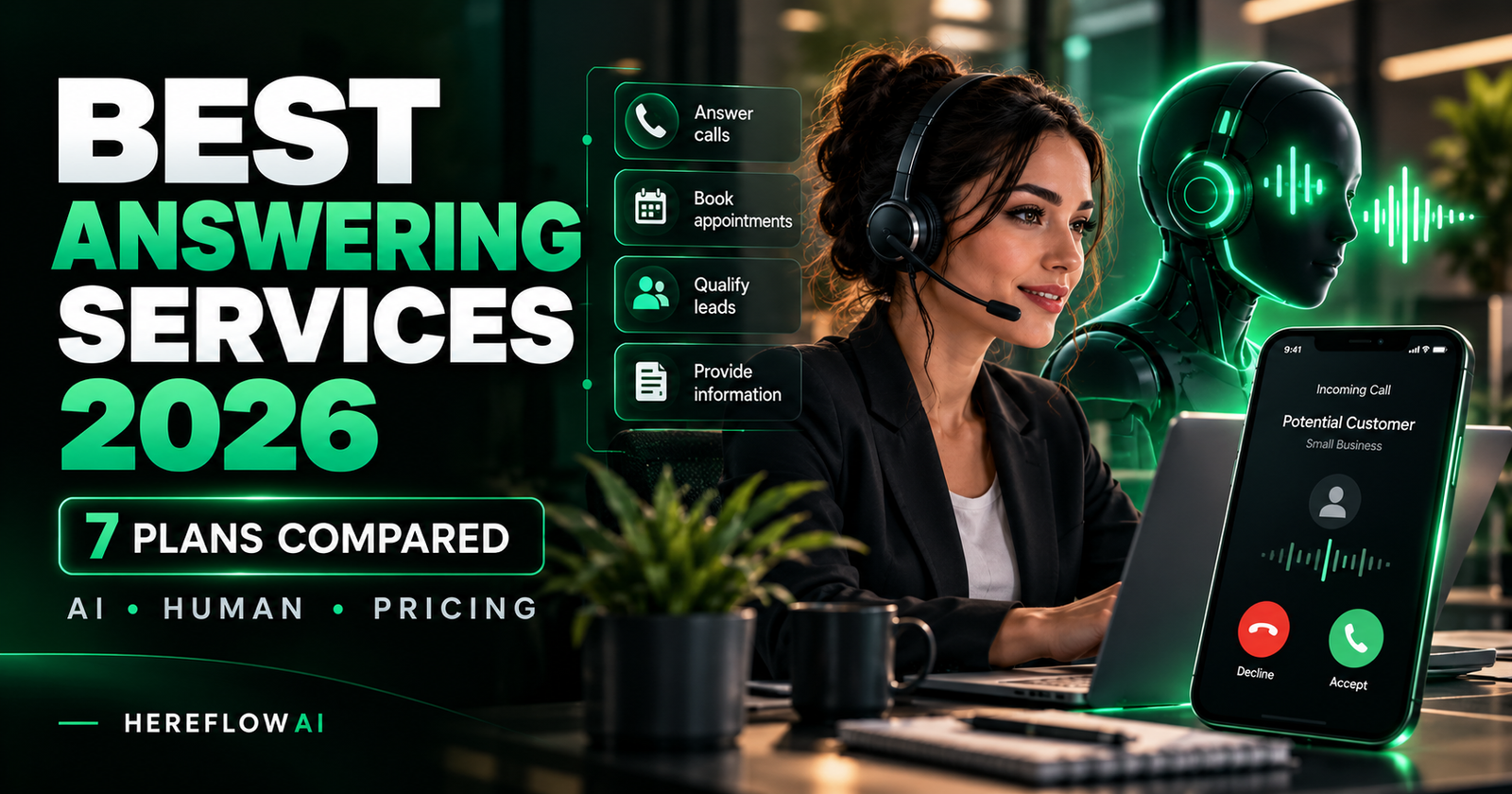
Quick answer: There is no single best answering service for every small business. For low-volume AI answering, consider Upfirst’s $24.95/month, 30-call plan. For AI priced by distinct callers, compare Goodcall’s $79/month, 100-customer plan. If you need real human receptionists, PATLive starts at $49/month before any billable minutes; AnswerConnect advertises $350/month for 200 minutes, plus an entry-plan setup fee; Ruby lists 50 live minutes at $250/month. The cheapest plan is not always the cheapest option for your call pattern.
This guide ranks seven specific service options by use case, compares prices with their actual billing units and walks through an illustrative 100-call month. It is a vendor shortlist, not a paid ranking or a claim that we personally subscribed to and evaluated every product.
Best small business answering services: quick comparison
| Service | Model | Public entry price | Our use-case pick |
|---|---|---|---|
| Upfirst | AI | $24.95/mo • 30 calls | Occasional calls, predictable fee |
| Goodcall | AI | $79/mo • 100 unique callers | Repeat callers, booking workflows |
| Smith.ai AI | AI + optional human handoff | Free 25 calls; Pro $150/mo • 75 calls | Qualification, integration and escalation |
| PATLive | Human | $49/mo • no minutes included | Very low-volume live calls |
| AnswerConnect | Human | $350/mo • 200 minutes + $49.99 setup | Consistent human call volume |
| Ruby | Human | $250/mo • 50 minutes | Personalized premium call experience |
| Smith.ai Live | Human | $300/mo • 30 calls | Lead intake with call-based billing |
Read the units: Upfirst and Smith.ai bill primarily by answered call, Goodcall measures unique phone numbers, PATLive/AnswerConnect/Ruby measure live receptionist minutes. The $49 PATLive plan does not include 50 minutes. Goodcall’s active website materials show some differences between older and newer plan details; verify overage prices in its checkout rather than relying on an archived screenshot.
If you’re unsure whether software or a real receptionist is appropriate in the first place, start with our separate AI Receptionist vs Answering Service comparison. This article goes further by comparing vendors and purchasing scenarios.
Which answering service should you choose? Seven practical shortlists
1. Upfirst — low-volume AI answering on a clear call allowance
Most relevant for: solo operators, tradespeople and small clinics with repetitive questions or missed calls who want to pilot automated answering without a large monthly commitment.
Upfirst advertises a Starter plan at $24.95/month for 30 calls, with an extra-call rate of $1.50. Its Premium tier lists $59.95/month for 90 calls, with $1 for each additional call. The provider advertises call summaries, spam filtering, calendar integrations, warm call transfers and multilingual handling. See the current Upfirst plans.
Watch out: A low entry price means little when your call volume rapidly exceeds the allowance. Test whether spam, transfers and repeated calls are counted as expected. Also validate appointment booking and actual handoff behavior before routing all customer calls through AI.
2. Goodcall — AI billing based on unique customers
Most relevant for: businesses receiving multiple calls from the same returning customers. Unlike minute-based services, Goodcall’s public pricing describes billing by unique customer: one telephone number during the billing month counts as one customer even if that person calls several times. Its current Starter entry price is $79/month for 100 unique customers.
Goodcall advertises workflows, connected tools and configurable agents. For a salon with customers who call repeatedly to reschedule, this billing structure may be worth comparing to per-call plans. Check Goodcall plans.
Watch out: A business with 100 different new callers may reach the allowance much faster than a business with 100 calls from 30 repeat customers. Verify current overage prices, seat/worker limits and connection restrictions.
3. Smith.ai AI — automated reception with optional live handoff
Most relevant for: teams that need lead qualification, calendars, integrations and a possible escalation path to a live receptionist. Smith.ai’s AI Receptionist has a free tier with 25 included calls and advertises a $150/month Pro plan with 75 calls. The site lists a $2.50 extra-call rate for the 75-call Pro configuration, and higher-volume tiers are available.
The vendor describes an optional live-agent escalation path; that is not the same as unlimited human answering included in the base AI plan. Ask exactly when a human transfer happens and how it is charged. See Smith.ai AI pricing.
Watch out: Verify the billing policy for answered, spam, failed and transferred calls, and whether the human assistance you need is actually covered in your estimate.
4. PATLive — human answering at very low volume
Most relevant for: businesses that insist on a real person but receive only occasional important calls. PATLive advertises $49/month pay-as-you-go with zero included live minutes and $2.99 per live minute. Packages with minutes are available, such as $99/month with 50 minutes and $349/month with 200 minutes.
PATLive says it uses US-based human receptionists for inbound answering, transfers, message-taking and appointment support. See PATLive pricing.
Watch out: The $49 plan is not a flat-rate call-answering plan. At higher call volume, calculate the effective cost and select the right minute bundle. Government taxes and fees may apply.
5. AnswerConnect — human answering for steady minute usage
Most relevant for: businesses with consistent call traffic that want real-person receptionists, basic scripts and CRM support. AnswerConnect publicly lists 200 minutes for $350/month on Entry, plus a $49.99 setup fee; the 300-minute Growth plan is $395/month without a setup fee on the published comparison.
Its website describes 24/7 human answering, lead intake, transfers and integration features. Review AnswerConnect’s live answering plans.
Watch out: Published billing rules round interactions up to whole-minute units. Even if you log 200 exact minutes, the billable total may differ. Request a simulated invoice using your call-length distribution.
6. Ruby — premium live-receptionist experience
Most relevant for: customer-facing firms that prioritize live greetings, consistent service, calendar support and bilingual coverage. Ruby lists 50 receptionist minutes for $250/month, 100 minutes for $395/month and 200 minutes for $720/month. Feature coverage is broad across tiers; the major pricing difference is the number of receptionist minutes.
See Ruby’s live-receptionist plans.
Watch out: A minute-based live service may become expensive for long calls. If callers mainly seek short answers, compare a software-first service; if calls are high-value and sensitive, the human approach may justify the price.
7. Smith.ai Live — human lead screening billed by call
Most relevant for: professional services with longer intake calls, including businesses that want live call qualification rather than minutes ticking up. Smith.ai’s human receptionist Starter plan advertises $300/month for 30 calls, while Basic lists $810/month for 90 calls. Published add-ons cover items such as appointment booking, messaging and specialized routing.
Review Smith.ai’s human plans and add-ons.
Watch out: The call allowance, transfer destinations, optional per-call features and high overage fees can affect total cost. Avoid selecting this premium service based solely on its entry price if call volume is uncertain.
What would 100 calls a month really cost?
Assume 100 answered calls from 100 different phone numbers, averaging two minutes each. That creates 200 conversational minutes. It is not a prediction of what you will be billed: each vendor’s metering rules are different. The figures below use a reasonable published plan that covers that scenario or uses stated overage fees.
| Service | Example calculation | Modeled monthly charge |
|---|---|---|
| Upfirst Premium (AI) | 90 calls at $59.95 + 10 extra × $1 | $69.95 |
| Goodcall Starter (AI) | 100 unique phone numbers within allowance | $79 |
| Smith.ai AI Pro | 75 calls at $150 + 25 extra × $2.50 | $212.50 |
| PATLive 200-minute (human) | Published 200-minute package | $349 + applicable taxes |
| AnswerConnect Entry (human) | 200-minute package; $49.99 entry setup | $350/month + initial setup |
| Ruby 200-minute (human) | Published 200-minute package | $720 |
For PATLive, AnswerConnect and Ruby, actual billable minutes may differ from the 200 conversational-minute assumption due to each provider’s counting and rounding rules. Extra features, taxes, plan commitments and overages are not included unless explicitly listed. A selected package is not proof that its feature quality is equal to another provider.
Decision lesson: At 100 relatively short calls, the illustrated AI packages are materially less expensive than live-receptionist minutes. But this tells you nothing about how accurately they perform your specific scheduling, qualification or complaint workflows. Test call outcomes before switching.
How to choose by business type, not by hype
Contractors, plumbers and electricians
Prioritize after-hours coverage, urgent call routing and qualified contact capture. Ask whether an AI system can distinguish a normal quote request from a real emergency and immediately transfer the latter. If emergency triage is business-critical, a live receptionist with explicit dispatch rules may be safer.
Salons, spas and appointment-heavy businesses
Prioritize real calendar write-back, cancellations, rescheduling and timezone handling. Test a booked appointment and a changed appointment end to end. A successful demo answer is not proof that the reservation appears in your calendar.
Agencies, consultancies and professional services
Prioritize lead qualification, detailed notes, call routing and CRM delivery. For high-value, sensitive intake, consider a human-first model or AI with live escalation. Require a written definition of what the receptionist may promise on behalf of your company.
Local retailers and ecommerce teams
Prioritize opening hours, order-status boundaries, returns-policy accuracy and reliable escalation. Avoid connecting a voice agent to an order system until permissions are restricted and refunds or payment-related actions have approval controls.
Six hidden costs people overlook
- Overage pricing: 30-call entry plans become expensive if you routinely receive 90 or 150 calls.
- Rounding and metering: 200 exact call minutes may not equal 200 billable receptionist minutes.
- Unique callers versus total calls: Repeat customers can make a per-customer plan more predictable, while many first-time callers can consume the allowance.
- Integrations: SMS, calendar setup, CRMs and premium routing may be separate products or fees.
- Human fallback: An AI plan with an optional live receptionist may bill you separately for transferred calls.
- Implementation and monitoring: Configuration, testing, incident handling and maintenance take time even if the subscription looks cheap.
Before you sign up: a 20-call real-world test
Run the same list of trial situations against your shortlisted providers. Use five routine questions, five appointment scenarios, five unusual requests and five explicit human-transfer or failure scenarios. Track correct answer, correct appointment outcome, accurate CRM notes, successful human escalation and unacceptable mistakes.
Make sure you test background noise, accents, long pauses, a customer changing their mind and an incorrect date. For live services, request documentation of the script, escalation procedures, actual coverage and add-on prices.
Do not trust any service with consequential decisions without appropriate controls. For healthcare, legal, financial and emergency-related cases, verify contractual, privacy and compliance requirements for your jurisdiction. A marketing statement about compliance is not a substitute for written verification.
What happens after the answering service captures a lead?
Answering a call is only the first step. Someone must respond, schedule, quote or follow up. If the receptionist creates a note but nobody owns the next action, the business may still lose the lead.
Read our lead follow-up automation guide and CRM lead follow-up guide. These cover reliable ownership, trigger timing and human checkpoints. This matters regardless of which answering provider you select.
HEREFLOWAI — WORKFLOW DESIGN, NOT A CALL-CENTER SUBSCRIPTION
Need a plan before you buy phone automation?
Our $49 AI Automation Audit examines one important business workflow and delivers a prioritized automation blueprint, tool-stack recommendations and clear human approval points. It can help you plan call intake and subsequent follow-up. It does not include creating, hosting or operating an AI receptionist, paid telephony or a live answering subscription.
FAQ about small business answering services
What is the cheapest answering service for a small business?
Among the offerings reviewed here, Upfirst advertises a $24.95 monthly AI tier including 30 calls, while PATLive’s human pay-as-you-go service starts at $49 monthly with zero minutes included. These are not equivalent services, and neither is necessarily the cheapest for your actual volume.
Can a small business answering service book appointments?
Some providers support scheduling, but the details differ. Ask which calendars are supported, whether availability is checked live, how cancellations work and whether booking is included in your plan or billed separately.
Is a virtual receptionist always a human?
No. “Virtual receptionist” can refer to a remote live human or AI software. Ask who answers the phone, whether the plan includes human transfers and how those interactions are billed.
Can I keep my existing business phone number?
Many providers advertise forwarding, hosted numbers or number portability. Confirm country coverage, caller ID behavior and what happens to your number when you cancel before signing up.
How many minutes do I need for 100 calls?
If an answered call averages two conversation minutes, that’s 200 conversational minutes. But a vendor may round each call to a full billable minute and apply other policies. Compare your last month’s real call distribution with the vendor’s billing rules.
Should I choose an AI or human service?
Choose based on the actual call mix. Routine FAQs, simple intake and after-hours requests may be a good AI pilot; sensitive exceptions and important relationship-heavy conversations may justify a human service. Our AI vs human answering guide explores that underlying decision in more detail.
Final buying checklist and next steps
Shortlist two providers with the right billing model for your call frequency and a third provider with a different approach. Confirm the full monthly fee, overage units, setup charges, cancellation terms, telephony setup and actual human handoff. Run the same test-call set before transferring your primary line.
If you need an inexpensive first look at AI, start by comparing Upfirst and Goodcall with your expected call pattern. If you definitely require live receptionists, compare PATLive, AnswerConnect, Ruby and Smith.ai Live according to your volume, intake complexity and desired service level. There is no universal winner without workload and call-quality evidence.
Sources and editorial methodology
All plan figures above were checked against Upfirst pricing, Goodcall pricing, Smith.ai AI pricing, PATLive pricing, AnswerConnect pricing, Ruby pricing and Smith.ai live pricing on October 13, 2026. The site has not independently run every service in production. Recommendations are use-case analyses from public plan details, not sponsored placement or firsthand quality rankings. All provider URLs in this article are direct links rather than unverified affiliate URLs. Pricing may vary with tax, region, annual discounts, usage and add-ons.

[…] and Goodcall advertises $79/month for 100 unique customers. These are not equivalent units. See our 7-provider answering service comparison if you are still choosing a product rather than hiring an […]
[…] of models and published supplier costs, read AI Receptionist vs Answering Service and our small-business answering service provider guide. Those articles cover general buyer decisions; this guide is specific to plumbing workflows and […]