
⚠️ Disclosure: This page contains affiliate links. If you buy through them, we may earn a commission at no extra cost to you. Prices verified September 2026.
Most comparisons treat these as two hosting companies. They aren’t.
Namecheap is a domain registrar that added hosting. Hostinger is a hosting company that added domains. That single fact explains every difference below — and points to an answer neither company will tell you.
💡 The answer most people should use: register your domain at Namecheap, host at Hostinger. You get the cheapest domain renewals and the fastest servers. Nothing stops you doing both.
Table of Contents
1. Why They’re Different Products
Namecheap built its business on domain registration. Hosting came later as an add-on — “register here, host here too.” The hosting works, but it was never the main product.
Hostinger built its business on hosting. Domains came later as a bundling perk.
Practically, that means:
| Namecheap | Hostinger | |
|---|---|---|
| Core strength | Domain registration | Hosting performance |
| Secondary product | Hosting | Domains |
| Best price | Domain renewals | Hosting intro rates |
You’re not choosing a better company. You’re choosing which product you need more.
Lorem ipsum dolor sit amet, consectetur adipiscing elit. Ut elit tellus, luctus nec ullamcorper mattis, pulvinar dapibus leo.
2. Hosting: Speed & Performance
Not close.
| Metric | Hostinger | Namecheap |
|---|---|---|
| TTFB (US) | ~188ms | ~300–350ms |
| Server stack | LiteSpeed + NVMe | Apache + cPanel |
| Caching | Native (LiteSpeed) | Plugin required |
| Data centres | 10 global | 4 |
The technical reason: LiteSpeed handles caching at server level. Apache needs a caching plugin configured properly to come close. On a fresh WordPress install with no optimisation, the gap is significant.
Honest caveat: for a small portfolio or blog getting a few thousand visits a month, a 150ms difference is real but not life-changing. It matters more as traffic grows.
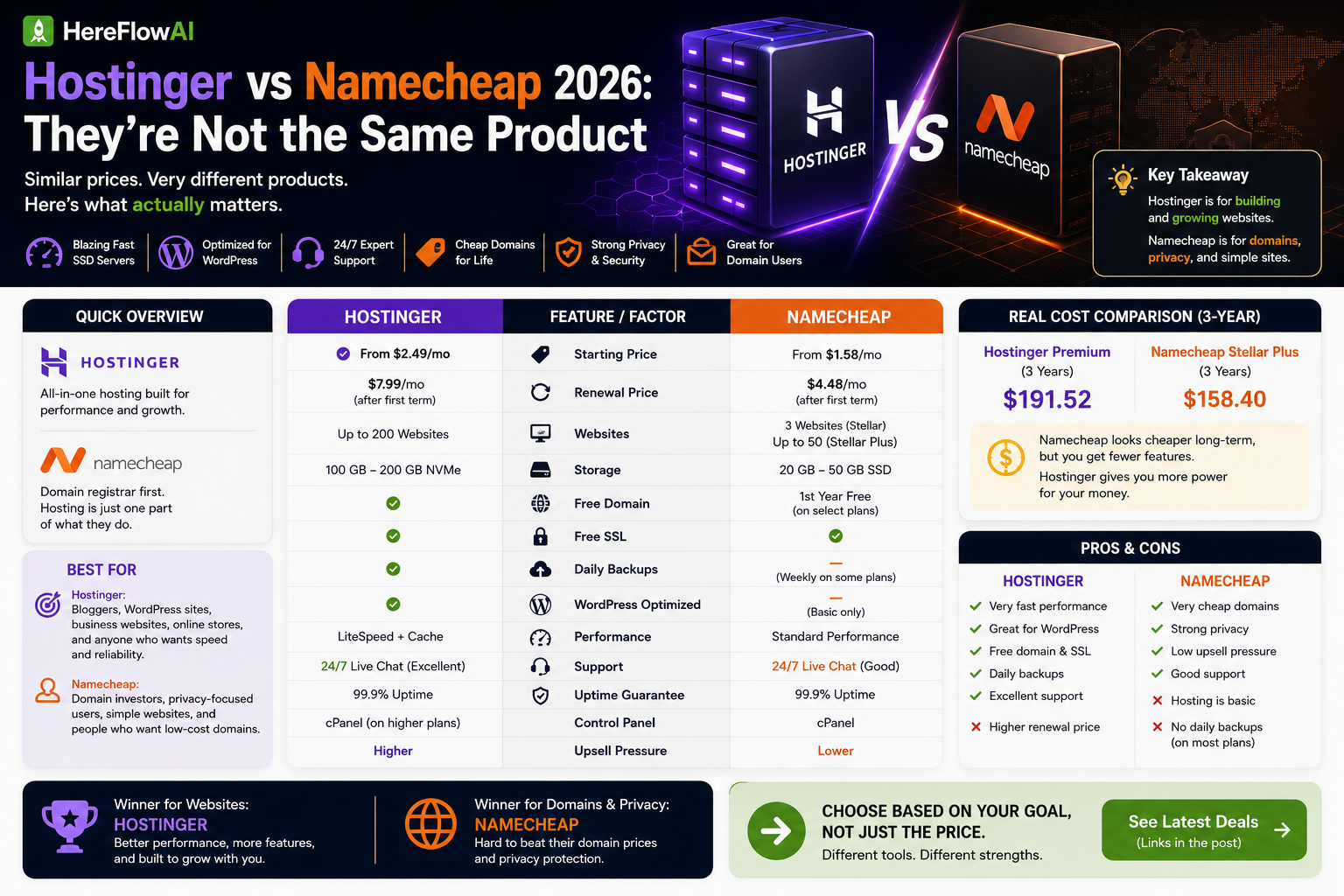
3. The Real Cost Over 4 Years
Here’s where reviews contradict each other — and both are right, depending on the plan.
Entry-level, single site:
| Year 1 | Years 2–4 | 4-Year Total | |
|---|---|---|---|
| Hostinger Single | ~$36 | ~$192 | ~$228 |
| Namecheap Stellar | ~$24 | ~$108 | ~$132 |
Namecheap is genuinely cheaper here. Its renewals are more stable.
Mid-tier, multiple sites:
| 4-Year Total | |
|---|---|
| Hostinger Premium | ~$143 + free domain |
| Namecheap Stellar Plus | ~$280 + paid domain (~$60) |
Hostinger wins by roughly $200.
🔑 The rule
1 site, absolute minimum spend  →  Namecheap cheaper
2+ sites, or want performance   →  Hostinger cheaper
⚠️ Hostinger’s lowest rates require 48 months paid upfront. Namecheap keeps prices lower on shorter terms — better if you don’t want to commit for four years.
4. Domains: Namecheap Wins Clearly
I’ll be direct — Namecheap is better at domains, and it isn’t close.
| Namecheap | Hostinger | |
|---|---|---|
| .com registration | ~$8.88/yr | Free year 1 |
| .com renewal | ~$18.48/yr | Separate charge |
| WHOIS privacy | ✅ Free forever | Varies |
| Domain dashboard | Registrar-grade | Basic |
Free lifetime WHOIS privacy is the standout. Most registrars charge $10–15/year for it. Namecheap includes it on every eligible domain, every renewal, permanently.
If you manage several domains, that alone is worth choosing them for.
5. The Hidden SSL Cost
This one catches people out.
Namecheap: free SSL for year one, then paid renewal — unless you’re on EasyWP.
Hostinger: free lifetime SSL on every domain you host.
It’s a small annual cost, but it’s the kind of charge that appears at renewal when you’d forgotten about it. Worth knowing before you commit.
6. Control Panel
Hostinger — hPanel: custom-built, guided, task-organised. Easier for a first site. Also includes Kodee, an AI assistant that can execute hosting tasks directly.
Namecheap — cPanel: industry standard. Every hosting tutorial ever written assumes cPanel. Steeper initial learning curve, but far more help available online.
Verdict: hPanel is easier to start with. cPanel is easier to find answers for. Neither should decide your purchase.
7. Full Comparison
| Feature | Hostinger | Namecheap | Winner |
|---|---|---|---|
| Hosting speed (TTFB) | ~188ms | ~300–350ms | 🟢 Hostinger |
| Server stack | LiteSpeed + NVMe | Apache | 🟢 Hostinger |
| Entry hosting (4yr) | ~$228 | ~$132 | 🔵 Namecheap |
| Mid-tier (4yr) | ~$143 | ~$280 | 🟢 Hostinger |
| .com renewal | Separate charge | ~$18.48/yr | 🔵 Namecheap |
| WHOIS privacy | Varies | ✅ Free forever | 🔵 Namecheap |
| SSL | ✅ Free lifetime | Year 1 only | 🟢 Hostinger |
| Control panel | hPanel | cPanel | 🟡 Depends |
| Data centres | 10 global | 4 | 🟢 Hostinger |
| Phone support | ❌ | ❌ | 🟡 Tie |
| Money-back | 30 days | 30 days | 🟡 Tie |
8. The Split Setup (What I’d Actually Recommend)
Nothing requires you to buy both from one company. The strongest setup in 2026:
Domain     →  Namecheap   (~$8.88/yr, free WHOIS privacy forever)
Hosting    →  Hostinger   (LiteSpeed, NVMe, hPanel)
What you get:
- Cheapest domain renewals in the industry
- Free privacy protection permanently
- Fastest budget hosting available
- One 30-day money-back guarantee on the hosting side
The tradeoff: two dashboards instead of one, and a one-time DNS setup (pointing your Namecheap domain to Hostinger’s nameservers — about 10 minutes, both companies document it).
For most people that tradeoff is worth it.
9. Who Should Pick Which
✅ Choose Hostinger if you:
- Want the fastest budget hosting available
- Are hosting 2+ websites
- Prefer a guided dashboard over cPanel
- Want free lifetime SSL
- Can commit to a longer term for the best rate
🔵 Choose Namecheap if you:
- Primarily need domain registration
- Want free WHOIS privacy forever
- Are hosting exactly one small site on the tightest budget
- Specifically want cPanel
- Don’t want to commit for 48 months
🟢 Choose both if you:
- Want the best of each — this is what I’d do
⚠️ One Thing to Monitor
CVC Capital Partners acquired a majority stake in Namecheap in September 2025. No pricing or service changes have been announced.
No action needed today. But private equity acquisitions in hosting have historically been followed by price increases, so it’s worth reading renewal notices carefully over the next couple of years.
Final Verdict
For hosting: Hostinger. Faster servers, more sites, better dashboard, free lifetime SSL.
For domains: Namecheap. Cheaper renewals, free privacy forever, better domain management.
For most people: both. Register at Namecheap, host at Hostinger. It costs nothing extra and gives you the strongest version of each.
If you genuinely want everything in one place, Hostinger is the better all-rounder — you’ll pay slightly more for domain renewals but get meaningfully better hosting.
FAQ
Is Hostinger better than Namecheap?
For hosting, yes — roughly 150ms faster TTFB, LiteSpeed servers, more sites per plan, and free lifetime SSL. For domain registration, Namecheap is better: cheaper renewals and free WHOIS privacy forever.
Which is cheaper, Hostinger or Namecheap?
It depends on the plan. On entry-level single-site hosting, Namecheap is cheaper over four years (~$132 vs ~$228). On mid-tier plans with multiple sites, Hostinger is cheaper (~$143 vs ~$280 plus domain costs).
Can I use Namecheap for domains and Hostinger for hosting?
Yes, and it’s the setup I’d recommend. You point your Namecheap domain at Hostinger’s nameservers — a one-time change taking about 10 minutes.
Does Namecheap include free SSL?
For the first year only on most plans, then it renews at a cost. Hostinger includes free lifetime SSL on every hosted domain.
Is Namecheap slower than Hostinger?
Yes, in benchmark tests — around 300–350ms TTFB versus Hostinger’s ~188ms. Namecheap runs Apache with cPanel; Hostinger runs LiteSpeed with NVMe storage.
Which has better support?
Both offer 24/7 chat. Hostinger scores higher in independent reviews for setup and support quality, but neither offers phone support.
Read next: Hostinger Review 2026 →
Also read: Hostinger vs Bluehost 2026 →