
⚠️ Disclosure: This page contains affiliate links. If you buy through them, we may earn a commission at no extra cost to you.
Almost every “Hostinger alternatives” article is written by a hosting company that wants your business. Read a few and you’ll notice each one concludes that its own product is the answer.
This one starts differently: what’s actually wrong?
Because for four of the five most common complaints, the fix isn’t a different host — it’s a different plan.
💡 Short version: if your problem is renewal price, Hostinger VPS renews at ~100% increase versus shared hosting’s ~300%. If your problem is phone support, no Hostinger plan fixes that — SiteGround does.
Table of Contents
1. Diagnose First
People search this term for five reasons. Find yours:
| Your complaint | Real fix |
|---|---|
| Renewal price too high | Different Hostinger plan |
| Only 1 site allowed | Different Hostinger plan |
| Weekly backups, not daily | Different Hostinger plan |
| Shared plan slowing down | Different Hostinger plan |
| No phone support | Actually leave → SiteGround |
| Need managed cloud at scale | Actually leave → Cloudways |
| Want a rate that never rises | Actually leave → Hetzner, flat-rate hosts |
Four of seven are solved without migrating. Migration costs you a weekend and risks downtime — worth avoiding when a plan change does the job.
2. Fix #1 — Renewal Price
The most common complaint by far. Hostinger’s shared renewals run 3–4× the intro rate.
But that ratio isn’t uniform across products:
| Product | Intro | Renewal | Increase |
|---|---|---|---|
| Shared Premium | ~$2.99/mo | ~$10.99/mo | ~300% |
| Shared Business | ~$3.99/mo | ~$16.99/mo | ~326% |
| VPS entry | ~$5.84/mo | ~$11.99/mo | ~100% |
🔑 The math nobody runs
Shared Premium at renewal:  ~$10.99/mo
VPS entry at renewal:       ~$11.99/mo
A dollar apart — but VPS gives you dedicated CPU, dedicated RAM, root access, and a dedicated IP.
If you’re technical and staying 3+ years, moving up to VPS beats moving out.
If you’re not technical: this doesn’t apply. A VPS you can’t administer is worse than shared hosting you can. Skip to section 5.
3. Fix #2 — Only One Site
If you’re on Single and need more, that’s a plan limit, not a host limit.
| Plan | Sites |
|---|---|
| Single | 1 |
| Premium | 3 |
| Business | 100 |
| Cloud Startup | 300 |
| For comparison: Bluehost Basic = 1 · SiteGround StartUp = 1 | |
Lorem ipsum dolor sit amet, consectetur adipiscing elit. Ut elit tellus, luctus nec ullamcorper mattis, pulvinar dapibus leo.
4. Fix #3 — Weekly Backups
Entry plans back up weekly. If your site earns money, that’s a real risk — you could lose six days of orders.
Business tier and above includes daily backups, plus a CDN and dedicated IP.
Cost of fixing this: about $1/month more at intro. Cost of migrating instead: a weekend plus migration risk.
5. When You Genuinely Should Leave
Three situations where no Hostinger plan helps:
1. You need phone support
Hostinger is chat and email only, at every tier. If being able to call someone during an outage matters, this is a genuine dealbreaker.
2. You need managed hosting at scale
High-traffic WordPress with someone else handling infrastructure. Hostinger doesn’t offer this.
3. You want a price that never increases
Every budget host raises prices at renewal. If you want predictability, you need a different category, not a different budget host.
6. The 6 Real Alternatives
🥇 SiteGround — for phone support & daily backups
Daily backups on every plan, phone support, Google Cloud infrastructure.
Catch: renewal is among the steepest in hosting — StartUp jumps to ~$17.99/mo, and it allows one site.
Choose if: you need phone support during outages.
🥈 Cloudways — for managed cloud
Highest-rated Hostinger alternative on G2 (~4.7/5 from 1,100+ reviews), praised for support and setup. Managed cloud on DigitalOcean, Vultr, AWS.
Catch: meaningfully more expensive. This is an upgrade, not a swap.
Choose if: you’re running high-traffic sites and want infrastructure managed.
🥉 Namecheap — for lowest ongoing cost
The most stable renewals in the budget tier, plus free lifetime WHOIS privacy.
Catch: slower hosting (~300–350ms TTFB vs Hostinger’s ~188ms), and SSL is free year one only.
Choose if: cost predictability matters more than speed.
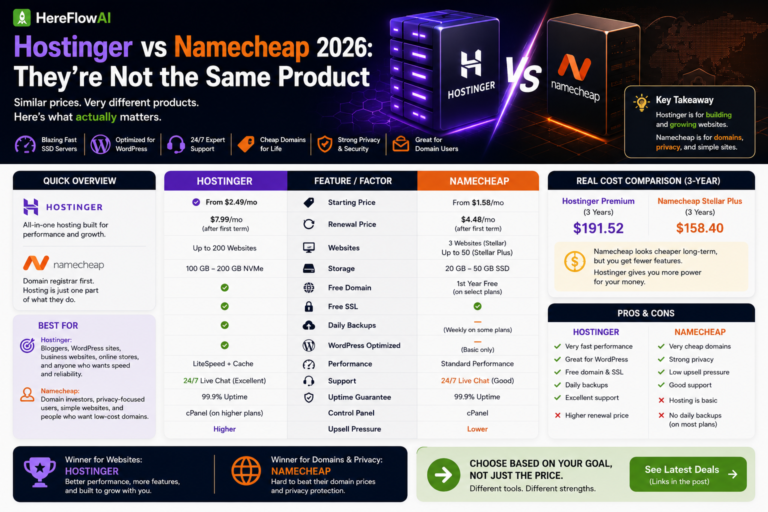
Full comparison: Hostinger vs Namecheap →
Bluehost — for cPanel & WordPress.org
Officially recommended by WordPress.org, unmetered bandwidth, cPanel.
Catch: renews higher than Hostinger, 10GB storage on entry, one site.
Choose if: you specifically want cPanel or that endorsement.
Full comparison: Hostinger vs Bluehost →
DreamHost — for multiple sites at entry
Privacy-focused, multiple sites on the entry plan, monthly billing without heavy penalty.
Choose if: you don’t want to prepay for years.
Hetzner — for raw price-to-performance
Cheapest performance per dollar in this list, no renewal trap.
Catch: self-managed. No hand-holding, no managed support.
Choose if: you’re comfortable administering a server yourself.
7. Comparison Table
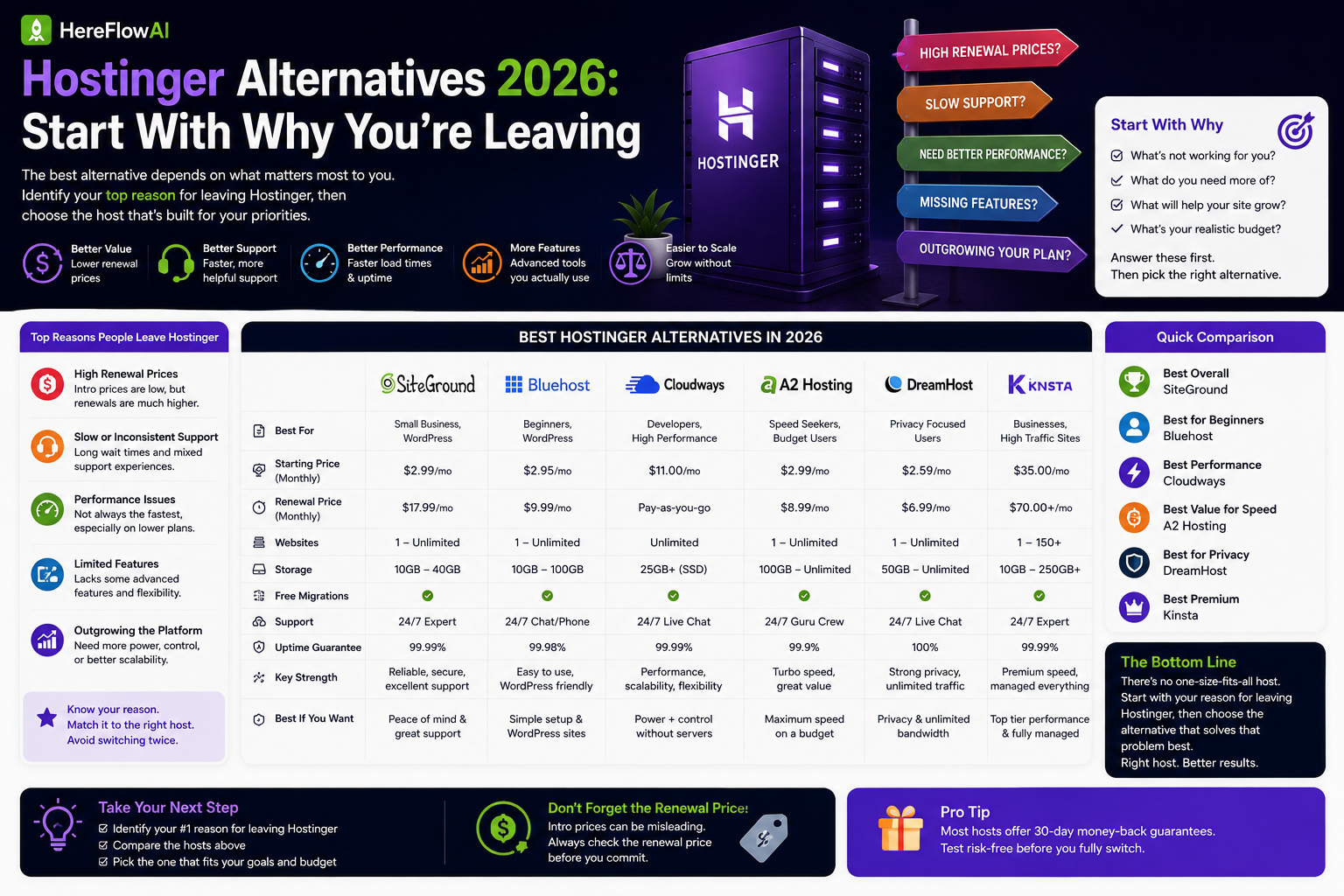
| Alternative | Best for | The catch |
|---|---|---|
| SiteGround | Phone support, daily backups on entry | Steepest renewal (~$17.99/mo), 1 site |
| Cloudways | Managed cloud, 4.7/5 on G2 | Significantly more expensive |
| Namecheap | Lowest ongoing renewal, free WHOIS privacy | Slower (~300–350ms TTFB), SSL year 1 only |
| Bluehost | cPanel, WordPress.org endorsed | Higher renewal, 10GB storage, 1 site |
| DreamHost | Multiple sites at entry, monthly billing | Smaller feature set |
| Hetzner | Raw price-to-performance, no renewal trap | Self-managed, no hand-holding |
8. Migration Reality
Before you decide, know what leaving actually costs:
Time: 2–6 hours for a typical WordPress site
Risk: DNS propagation can take up to 48 hours; email downtime is common
Cost: free migration is offered by most hosts, but “free” usually means queued
The honest calculation:
Plan upgrade:  ~$1–5/month more, zero downtime
Migration:     a weekend + propagation risk
For a renewal-price complaint, upgrading within Hostinger usually wins. For a phone-support complaint, no upgrade helps — migrate.
Final Verdict
Most people searching “Hostinger alternatives” don’t need one. They need a different Hostinger plan.
Renewal too high and you’re technical? VPS renews at ~100% versus shared hosting’s ~300%. Need more sites? Premium or Business. Need daily backups? Business.
Genuinely leave if: you need phone support (SiteGround), managed cloud at scale (Cloudways), or a price that never rises (Hetzner, flat-rate hosts).
Everything else is a plan change, and a plan change takes ten minutes instead of a weekend.
FAQ
What are the best Hostinger alternatives in 2026?
SiteGround for phone support and daily backups, Cloudways for managed cloud, Namecheap for the lowest ongoing renewal, Bluehost for cPanel, DreamHost for multiple sites at entry level, and Hetzner for self-managed price-to-performance.
Why do people look for Hostinger alternatives?
The most common reasons are renewal price increases of 3–4×, site limits on entry plans, weekly rather than daily backups, and the absence of phone support.
Is there a cheaper alternative to Hostinger?
Namecheap has more stable renewals, and Hetzner offers better raw price-to-performance if you can self-manage. At intro pricing, Hostinger remains among the cheapest.
Should I switch from Hostinger or upgrade my plan?
If your complaint is renewal price, site limits, or backup frequency, upgrading is usually faster and cheaper than migrating. If you need phone support or managed cloud, no Hostinger plan solves it.
Is Hostinger VPS cheaper than shared hosting long-term?
At renewal they’re close — around $11.99/mo for VPS versus $10.99/mo for shared Premium. VPS renewals increase roughly 100% versus shared hosting’s 300%, so over several years VPS often costs less for more resources.
How long does migrating hosts take?
Typically 2–6 hours of work for a WordPress site, plus up to 48 hours of DNS propagation. Most hosts offer free migration, though it’s usually queued rather than immediate.
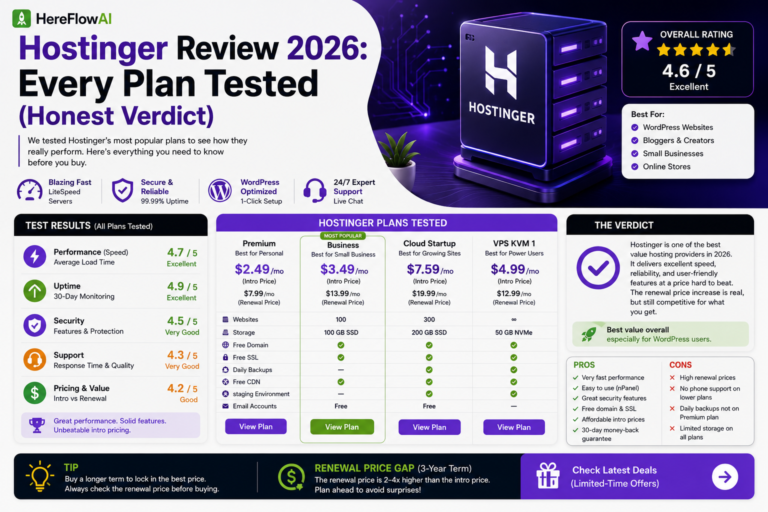
Read next: Hostinger Review 2026 →
Also read: Hostinger vs SiteGround 2026 →