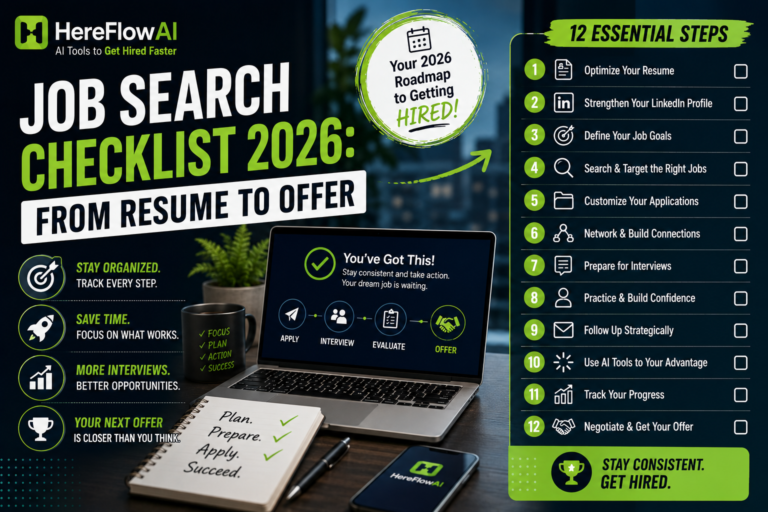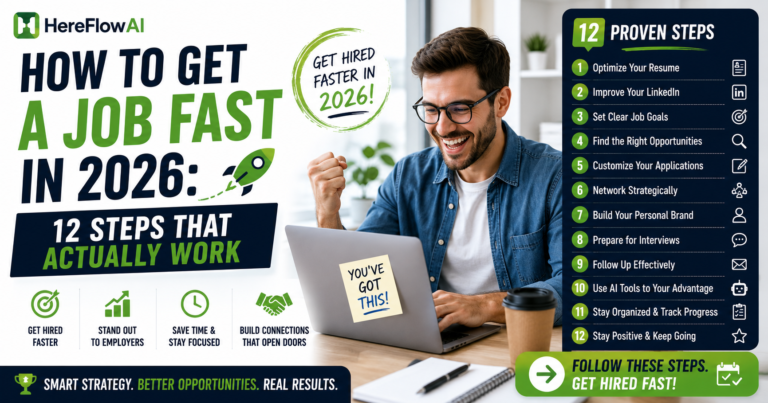
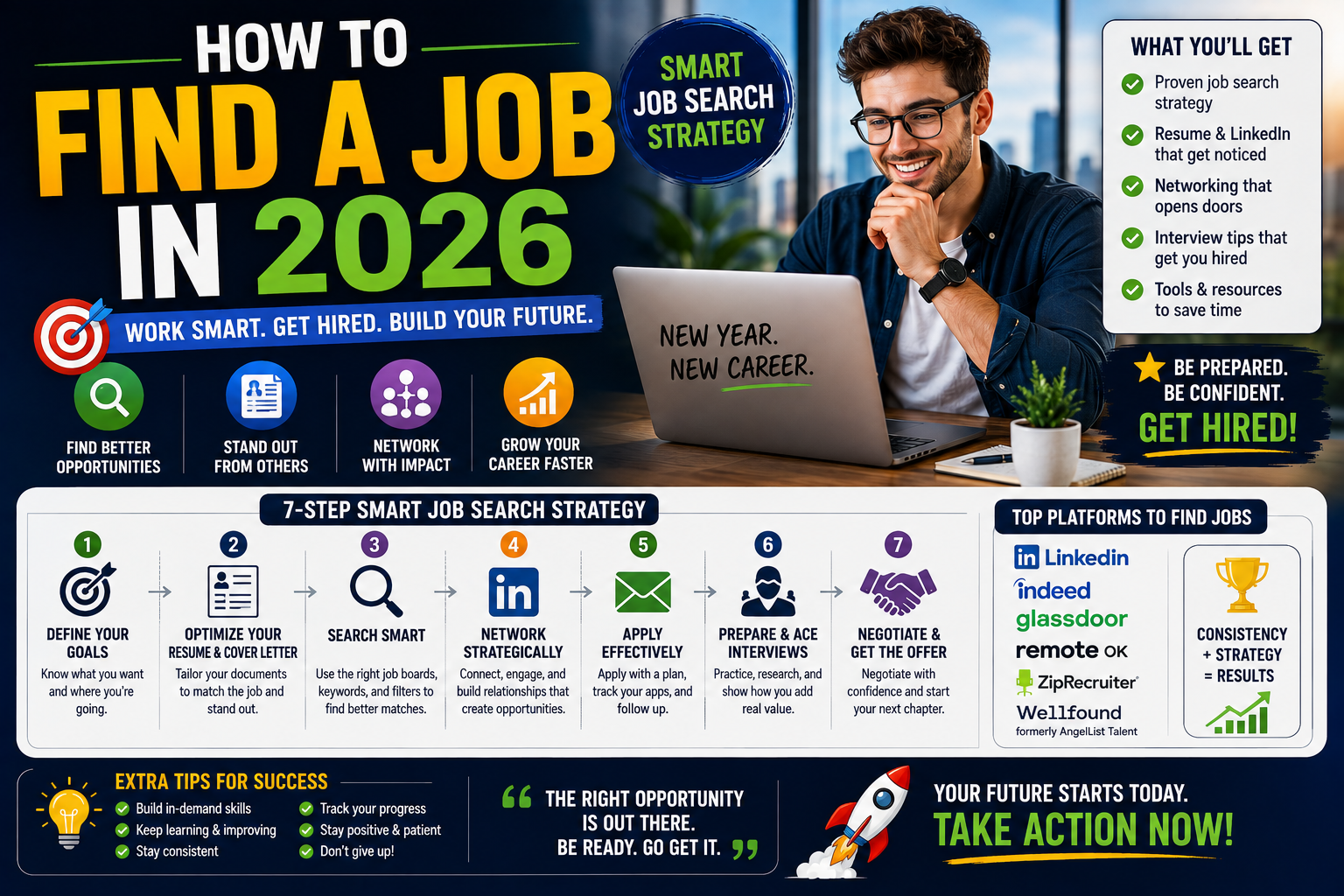

Learning how to find a job in 2026 can feel overwhelming, especially when you are sending applications without getting enough responses or interviews. A smarter job search strategy can help you target better opportunities, improve your applications, and make the entire process more organized.
Instead of treating job hunting like a lottery, you can treat it like a system:
Target → Research → Apply → Track → Improve
This guide will show you how to build that system step by step.
Table of Contents
1. Why Random Job Applications Often Fail
One of the most common job-search mistakes is assuming that more applications automatically create better results.
A typical routine looks like this:
Find a vacancy.
Click Apply.
Upload a resume.
Move to the next vacancy.
Repeat.
This can feel productive because you are constantly taking action.
But activity and progress are not the same thing.
If the positions are poorly matched to your experience, your resume does not clearly demonstrate the required skills, or your application looks identical to hundreds of others, increasing the number of applications may simply repeat the same problem.
A smarter job search strategy focuses on both quantity and quality.
For example:
Candidate A
Sends 100 almost identical applications.
Most jobs only partially match their background.
They do not track results or modify their strategy.
Candidate B
Sends 35 targeted applications.
They select relevant opportunities, adjust their resume, track responses, research companies, and follow up when appropriate.
Candidate B may submit fewer applications but can potentially create a much stronger interview rate.
The goal is not to apply less.
The goal is to apply better.
2. Define Your Career Target Before You Start Applying
A strong job search starts with clarity.
If you search using broad terms such as:
“Engineering jobs”
“Marketing jobs”
“Remote work”
“Quality jobs”
you may receive thousands of results that have little connection to your actual experience.
Instead, define two or three specific job titles.
For example, someone with quality-control experience might target:
- Quality Control Inspector
- QA/QC Inspector
- Welding Inspector
Someone working in digital marketing might target:
- SEO Specialist
- Content Marketing Specialist
- Digital Marketing Coordinator
Your career target should ideally include:
- Target job titles
- Target industries
- Preferred locations
- Remote, hybrid, or on-site preference
- Experience level
- Important technical skills
- Salary expectations
- Companies you would like to work for
The clearer your target becomes, the easier every later step becomes.
You can search more efficiently, customize your resume more accurately, and explain your career goals more confidently during interviews.
3. Build an ATS-Friendly Resume
Your resume is often the first serious evaluation of your application.
Many companies use Applicant Tracking Systems, commonly known as ATS, to store, organize, and search applications.
That is why following a basic ATS resume guide can improve the readability of your resume.
You do not need to manipulate the system or stuff your resume with keywords.
Your goal is much simpler:
Make your resume easy to understand.
Use clear sections
Use familiar headings such as:
- Professional Summary
- Work Experience
- Education
- Skills
- Certifications
Avoid unusual section names that may confuse either recruiters or software.
Keep the design readable
A visually attractive resume can still be simple.
Avoid unnecessarily complicated tables, graphics, icons, progress bars, and decorative elements that make your information harder to scan.
Use relevant keywords naturally
Read the job description carefully.
Look for skills, tools, certifications, responsibilities, and industry terminology that appear repeatedly.
If you genuinely have those qualifications, make sure they are visible in your resume.
Do not simply copy the job advertisement.
Show evidence.
Instead of:
Responsible for quality control.
Consider something more specific such as:
Performed visual and dimensional inspections of fabricated components and documented non-conformities according to project quality requirements.
Specific information communicates much more value.
4. Stop Sending the Exact Same Resume Everywhere
You do not need to create an entirely new resume for every vacancy.
But important applications should be adjusted.
Imagine that your background includes:
- Inspection
- Documentation
- Technical reporting
- Supplier quality
- Welding
- Dimensional control
One vacancy may emphasize welding inspection.
Another may focus on supplier documentation.
Your experience can qualify you for both jobs, but the most important information is different.
For each strong opportunity:
Adjust your professional summary
Make sure the first few lines reflect the target position.
Prioritize relevant skills
Move the most important skills higher.
Improve relevant experience bullets
Make the experience most connected to the vacancy easy to find.
Check terminology
Use industry terminology that accurately reflects your experience.
Small improvements across multiple applications can make a significant difference.
5. Build a Multi-Channel Job Search Strategy
Job boards are useful.
But they should not be your entire job search.
A stronger strategy combines several channels.
Job Boards
Use platforms relevant to your location and industry.
LinkedIn can help you discover jobs, recruiters, hiring managers, and companies.
It can also allow recruiters to discover you.
Company Career Pages
Some companies publish vacancies directly on their websites before they appear elsewhere.
Build a list of target companies and check their career pages regularly.
Recruiters
Recruiters can be valuable, especially in specialized industries.
Connect professionally and make your experience and target position clear.
Networking
Professional relationships can sometimes reveal opportunities that are not widely advertised.
Networking does not mean asking strangers for jobs.
It means creating professional relationships and making your expertise visible.
Direct Outreach
In selected situations, a short professional message to the right recruiter or hiring manager can help.
A good job search usually uses several channels simultaneously.
6. Research the Company Before Applying
Before submitting an important application, spend five to fifteen minutes researching the employer.
Look at:
- What the company does
- Its main industry
- Recent projects
- Products or services
- Office locations
- Job requirements
- Company size
- Skills mentioned in similar vacancies
This helps you answer an important question:
Is this actually a good opportunity for me?
Research also helps you write stronger cover letters, prepare for interviews, and communicate more intelligently with recruiters.
Practical Example
Imagine two companies advertising the same job title.
Company A works mainly in industrial construction.
Company B works primarily in pharmaceutical manufacturing.
The job title may be identical, but the experience they value could be very different.
Understanding the company allows you to emphasize the right parts of your background.
7. Follow a Job Application Guide Instead of Applying Randomly
Create a repeatable process.
Before submitting an important application, use this job search checklist:
Job Application Checklist
✅ Read the entire vacancy
✅ Identify essential requirements
✅ Check whether your experience is relevant
✅ Research the company
✅ Identify important skills and keywords
✅ Adjust your resume
✅ Review your LinkedIn profile
✅ Prepare a cover letter if needed
✅ Check grammar and contact information
✅ Submit the application
✅ Save the job description
✅ Add the application to your tracker
✅ Schedule a possible follow-up
This process may take slightly longer than clicking Easy Apply repeatedly.
But the quality of your applications becomes much stronger.
8. Track Every Job Application
One of the easiest ways to improve your job search is to track it.
You can use:
- Excel
- Google Sheets
- Notion
- A dedicated job tracking tool
- A simple job search workbook
Your tracker can contain:
| Information | Example |
|---|---|
| Company | ABC Industries |
| Job Title | Quality Inspector |
| Date Applied | August 20 |
| Location | Paris |
| Source | |
| Contact | Recruiter Name |
| Status | Applied |
| Follow-Up | August 27 |
| Interview | Pending |
| Notes | Requires VT/PT |
Tracking prevents confusion and gives you something even more important: data.
9. Learn How to Get More Job Interviews
Suppose you send 40 applications and receive zero interviews.
That is useful information.
It suggests that something earlier in your process may need improvement.
Possible problems include:
- Poor job targeting
- Weak resume positioning
- Missing relevant keywords
- Applying to positions above your experience level
- Applying too late
- Weak professional summary
- Limited geographic flexibility
- Poor presentation of achievements
If you receive many interviews but no offers, however, your resume may not be the main problem.
Your interview performance may require more attention.
This is why learning how to get more job interviews requires measurement.
Think of your job search as a funnel:
Opportunities Found → Applications → Responses → Interviews → Final Interviews → Offers
Find the stage where people stop progressing.
Then improve that stage.
10. Prepare for Interviews Before You Receive an Invitation
Many candidates wait until they receive an interview invitation before preparing.
You can prepare much earlier.
Create answers for common questions such as:
- Tell me about yourself.
- Why are you interested in this position?
- Why do you want to leave your current job?
- What are your strengths?
- Tell me about a difficult problem you solved.
- Describe a disagreement at work.
- Tell me about a mistake you made.
- What salary are you expecting?
The goal is not to memorize robotic answers.
The goal is to know your experience well enough to explain it clearly.
11. Build a STAR Story Bank
Behavioral interviews often ask questions such as:
“Tell me about a time when…”
A useful answering framework is STAR:
Situation → Task → Action → Result
For example:
Situation
A production inspection identified a defect before final acceptance.
Task
You needed to document the problem and ensure the issue was corrected.
Action
You identified the non-conformity, documented the affected area, communicated with the responsible team, and verified the corrective action.
Result
The issue was corrected before final acceptance, reducing the risk of a later quality problem.
Create several STAR stories covering:
- Problem solving
- Teamwork
- Leadership
- Technical challenges
- Conflict
- Mistakes
- Process improvement
- Customer problems
- Difficult deadlines
You can adapt these stories to multiple interview questions.
12. Common Job Search Mistakes to Avoid
Even qualified candidates can hurt their chances through small mistakes.
Applying to Everything
More vacancies do not automatically mean more opportunities.
Prioritize jobs where your background genuinely matches.
Using One Generic Resume
Recruiters should immediately understand why your experience is relevant to their vacancy.
Ignoring LinkedIn
A strong resume with a weak or outdated LinkedIn profile can create inconsistency.
Not Tracking Applications
Without tracking, you cannot reliably measure results.
Applying and Doing Nothing Else
Applications should be combined with networking, company research, recruiter outreach, and follow-up.
Using AI to Invent Experience
AI can help improve communication.
It should never create fake skills, projects, certifications, or achievements.
Giving Up Too Quickly
Job searches often take time.
What matters is whether your results are improving.
13. Follow a Practical 30-Day Job Search Plan
A structured 30 day job search plan can prevent you from becoming overwhelmed.
Week 1: Build the Foundation
Focus on:
- Career targeting
- Resume improvement
- LinkedIn optimization
- Skills inventory
- Target job titles
Your objective is to prepare before increasing application volume.
Week 2: Build Your Opportunity Pipeline
Create a list of:
- Target employers
- Job boards
- Recruiters
- Company career pages
- Relevant LinkedIn searches
Start submitting targeted applications.
Week 3: Increase Visibility
Continue applying while adding:
- LinkedIn connections
- Recruiter outreach
- Networking
- Follow-ups
- Interview practice
Week 4: Review Your Results
Ask:
How many jobs did I apply to?
How many responses did I receive?
How many interviews?
Which job titles generated the most interest?
Which resume version worked best?
Which channels generated opportunities?
Then adjust the next 30 days.
14. How to Find a Job When Your Current Strategy Is Not Working
If you have been applying for several weeks without progress, avoid changing everything randomly.
Change one variable at a time.
Step 1: Review Your Target
Are the jobs realistically aligned with your experience?
Step 2: Review Your Resume
Can a recruiter understand your value in ten seconds?
Step 3: Review Your Application Sources
Are you depending on one job board?
Step 4: Review Your Timing
Are you applying to newly posted opportunities or jobs that have already received hundreds of applications?
Step 5: Review Your Positioning
Does your professional profile clearly communicate what you do?
Step 6: Measure Again
Continue for another period and compare results.
This is how to improve your job search systematically.
Instead of guessing, you learn from your own data.
15. Should You Use AI for Your Job Search?
Yes — but use it correctly.
AI can be useful for:
- Analyzing job descriptions
- Identifying relevant keywords
- Improving resume bullet points
- Preparing interview questions
- Practicing interview answers
- Drafting professional emails
- Improving cover letters
- Researching career paths
- Creating job-search routines
- Reviewing weekly progress
For example, instead of asking AI:
“Write me a perfect resume.”
Try:
“Compare my resume with this job description. Identify the five most important requirements and show me which ones are already supported by my real experience.”
That produces a much more useful result.
AI should strengthen your real experience.
It should not replace it.
Free Job Search Checklist
Before finishing, here is a quick checklist you can use today.
Career Target
☐ I know the 2–3 job titles I am targeting.
☐ I know my preferred industries.
☐ I have identified target locations.
Resume
☐ My resume is easy to read.
☐ My most relevant experience appears clearly.
☐ My contact information is correct.
☐ I have adapted the resume to important vacancies.
☐ My headline explains what I do.
☐ My experience matches my resume.
☐ My skills are updated.
Applications
☐ I research important companies.
☐ I track every application.
☐ I save important job descriptions.
☐ I follow up selectively.
Interviews
☐ I have prepared my introduction.
☐ I have several STAR stories.
☐ I have researched salary expectations.
☐ I can clearly explain why I want the role.
Lorem ipsum dolor sit amet, consectetur adipiscing elit. Ut elit tellus, luctus nec ullamcorper mattis, pulvinar dapibus leo.
Download the Free Smart Job Search System
Knowing what to do is useful.
Having an organized system that you can follow is even better.
That is why HereFlowAI created The Smart Job Search System.
The free digital guide walks you through the entire job-search process, including:
✅ Career targeting
✅ Resume improvement
✅ LinkedIn strategy
✅ Job application systems
✅ Interview preparation
✅ Job-search tracking
✅ Practical checklists
✅ 30-day job search system
✅ Ready-to-use AI prompts
Stop applying randomly.
Build a repeatable system you can measure and improve.
Frequently Asked Questions
What is the best way to find a job in 2026?
A strong job search combines targeted applications, an ATS-friendly resume, LinkedIn, company research, networking, application tracking, interview preparation, and regular analysis of your results.
How many jobs should I apply to every day?
There is no perfect number. Five carefully selected applications can sometimes be more useful than 30 random ones. Aim for consistent activity while maintaining application quality.
Should I use the same resume for every job?
Your core resume can remain similar, but important applications should be tailored so that your most relevant skills and experience are easy for recruiters to identify.
How can I get more job interviews?
Start by improving your job targeting and resume. Then track your application-to-interview rate and review which positions, companies, and application channels generate the best results.
Does LinkedIn really help with job searching?
Yes. LinkedIn can help you discover vacancies, connect with recruiters, research employers, build professional visibility, and potentially be discovered by hiring teams.
Can AI help me find a job?
AI can help analyze job descriptions, improve resume wording, prepare interview answers, organize applications, and draft professional communication. However, it should never invent qualifications or experience.
What should I include in a job search tracker?
At minimum, track the company, job title, application date, source, status, recruiter or contact, follow-up date, interview information, and notes.
How long does it take to find a job?
There is no universal timeline. It depends on your experience, location, industry, target role, economic conditions, and strategy. Instead of focusing only on time, monitor whether your applications are generating more responses and interviews.
Final Thoughts
Learning how to find a job is not about discovering one secret platform or sending hundreds of applications.
It is about building a process.
Define the right target.
Present your experience clearly.
Search across multiple channels.
Choose relevant opportunities.
Tailor important applications.
Track what happens.
Prepare for interviews.
Review your results.
Improve what is not working.
Once you start treating your job search as a system rather than a series of random applications, the process becomes easier to understand, measure, and improve.
And every application becomes part of a bigger strategy.
Recommended Next Reads:
AI tools
→ Best AI Writing Tools for Job Applications
freelancing
→ How to Start Freelancing in 2026
Fiverr
→ How to Make Money on Fiverr Fast in 2026