
Table of Contents
Fast learners rarely have special talent — they have a better process. They spend their effort on the parts of a skill that matter most, they practise in a way that targets weaknesses, and they review smartly so they do not forget. Slow learners often put in similar hours but on low-value activities: re-reading notes, repeating what they can already do, and cramming everything at once.
The good news: learning speed is trainable. Once you adopt deliberate practice, retrieval-based review, and good recovery habits, you compress the time it takes to reach competence.
💡 HereFlowAI Tip: The people who learn fastest in 2026 use AI as an always-on tutor and lean on the structure and credibility of a proven platform when it counts.
The 20-Hour Rule — How Fast Can You Learn?
Josh Kaufman’s research shows 20 hours of deliberate practice is enough to reach functional competence in most skills, and 30 days at 60 to 90 minutes a day comfortably exceeds that threshold. You will not match a 10-year veteran, but you will match someone with a year of casual exposure.
Basic competence in most skills takes 20–40 hours of focused practice. To reach job-ready proficiency, expect 3–6 months of consistent daily learning. Mastery takes years, but you don’t need mastery to start benefiting from a skill.
Method #1 — The 80/20 Rule of Skill Learning
Prioritize practice in areas that offer the highest return on investment. Mastering core principles, high-impact techniques, or essential vocabulary is a good place to start. With the 80/20 rule, you’ll avoid spending too much time on less important aspects and focus on what matters most for fast progress.
- Identify the 20% of the skill that produces 80% of results
- Focus there first — ignore the rest until you’re functional
- Example: Learning SEO? Master keyword research + on-page optimization first — everything else comes after
Method #2 — Deliberate Practice
Deliberate practice is focused, structured effort aimed at improving a specific weakness, with clear goals and immediate feedback. It means working slightly beyond your comfort zone and correcting mistakes, rather than repeating what you can already do. Quality of practice matters far more than quantity.
The difference:
- ❌ Passive: Watching a Udemy tutorial for 2 hours
- ✅ Deliberate: Pausing every 10 minutes and immediately applying what you just learned
Method #3 — Active Recall + Spaced Repetition
Active recall means closing your notes and trying to reconstruct or explain what you learned from memory — through self-quizzing, practice questions, or free recall. Retrieving information strengthens the memory far more than re-reading it, even though re-reading feels more productive.
Spaced repetition means reviewing material at increasing intervals over days and weeks rather than cramming it once. Each time you retrieve something just as you are about to forget it, the memory becomes more durable.
Tool to use: Anki (free flashcard app) — used by medical students worldwide for high-retention learning.
Method #4 — The Feynman Technique
The Feynman technique says that teaching someone else is one of the best ways to learn. When you explain a concept in simple words, you’ll notice gaps in your understanding and reinforce your learning. Pick a topic you’re learning, teach it as if explaining it to a beginner, identify knowledge gaps, and go back to study those areas; then simplify and repeat until you can explain the topic confidently.
Practical application: Write a short blog post or LinkedIn article explaining what you just learned — this forces you to fill gaps and solidifies understanding.
Method #5 — Micro-Learning (10–15 Minutes Daily)
Instead of marathon study sessions, break learning into tiny chunks. Why it works: your brain retains information better through spaced repetition than cramming. According to research from the National Training Laboratories, active learning methods increase retention by up to 75% compared to passive watching.
Daily schedule that works:
- 10 min morning — review previous session (active recall)
- 20 min evening — new content + immediate practice
- Weekend — build one small project applying the week’s learning
Method #6 — Use AI as Your Personal Tutor
The hybrid approach — a proven course as backbone, Anki for retention, and ChatGPT as drilling partner — is what most successful 30-day learners now use.
How to use AI for faster learning:
- Ask ChatGPT to quiz you on what you just learned
- Use Claude to explain concepts in simpler terms when stuck
- Ask AI to generate practice scenarios specific to your skill
- Use AI to review your work and give feedback instantly
Method #7 — Build Real Projects Immediately
Create and deploy projects to practice what you’ve learned. Your skills will improve as you consistently apply theoretical knowledge to solve real-world problems. Moreover, your projects contribute to your professional portfolio, which you can present to employers when applying for jobs.
A Harvard study found that students using project-based techniques mastered programming 40% faster than peers using passive methods.
Rule to follow: After every 2 tutorials maximum — start a real project. No exceptions.
Method #8 — The Pomodoro Technique
The Pomodoro technique is a fantastic framework for time management during learning sessions — solid for maintaining productivity, staying focused, and preventing burnout.
How it works:
- 25 minutes focused learning (no distractions)
- 5-minute break
- Repeat 4 times → 30-minute longer break
- Track sessions to build consistency
Best Platform to Learn Skills Fast in 2026
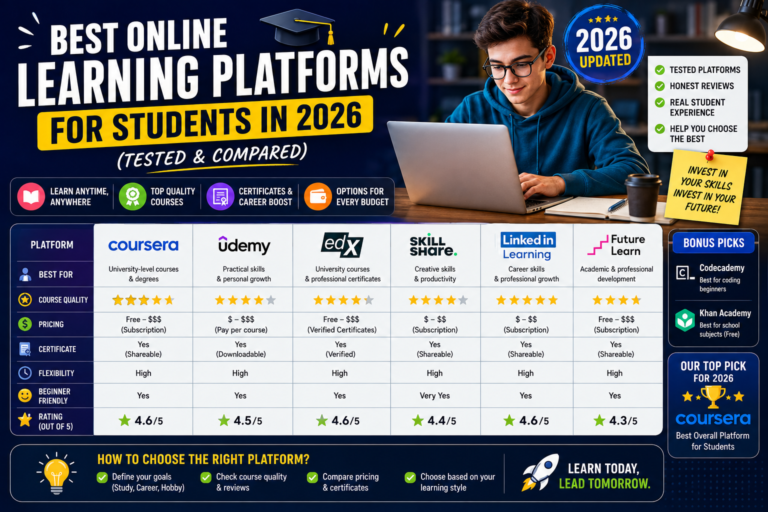
The best way to learn new skills online in 2026 is to use specialized platforms that match your goal: Coursera for professional certificates, Udemy for specific practical skills, Khan Academy for free foundational learning, and LinkedIn Learning for career advancement.
For freelancers and job seekers — Udemy wins:
- Specific, practical courses
- Self-paced — no deadlines
- Sales every 2–3 weeks — most courses $9.99–$14.99
- 30-day refund if the course doesn’t deliver
| Platform | Best For | Free Option | Certificate |
|---|---|---|---|
| Udemy | Specific skills, freelancing | ❌ | ✅ Completion |
| Coursera | Professional certificates | ✅ Audit | ✅ Accredited |
| Khan Academy | Foundational learning | ✅ Yes | ❌ |
| LinkedIn Learning | Career advancement | ✅ 1 month |
Final Verdict
Learning a new skill in 2026 looks nothing like it did five years ago. AI can explain any concept on demand, generate unlimited practice, and review your work in seconds.
The methods in this guide aren’t about studying harder — they’re about studying smarter. Apply the 80/20 rule to pick the right things to learn. Use deliberate practice to improve faster. Use AI as your tutor. Build projects from day one. And use Udemy’s affordable, structured courses to give your learning the right foundation.
You will not become a world-class expert in a month. Still, you can absolutely move from zero to genuinely useful, employable, and confident in many modern skills in 30 days of consistent effort.
FAQ
How long does it take to learn a new skill?
Josh Kaufman’s research shows 20 hours of deliberate practice is enough to reach functional competence in most skills. Job-ready proficiency typically takes 3–6 months of consistent daily learning.
What is the fastest way to learn a new skill?
Break the skill into subskills, focus first on the few that give most of the result, and practise them deliberately with immediate feedback. Then lock in what you learn using active recall and spaced repetition instead of passive re-reading.
Is 30 minutes a day enough to learn a new skill?
Yes — consistency matters more than duration. Research shows daily micro-learning in 10–15 minute sessions outperforms occasional marathon sessions for long-term retention.
How do I stay motivated when learning a new skill?
Most plans fail not on day 30 but on day 11, when the dopamine wears off. Anticipate the dip — it is normal, it ends, and on the other side is the real skill. Track your progress visually and commit to a specific daily time slot.
Is Udemy good for learning skills fast?
Yes — Udemy’s self-paced format, practical focus, and affordable sale prices make it one of the best platforms for fast, structured skill learning in 2026.
Can I use AI to learn faster?
Yes — the fastest learners in 2026 combine AI as an always-on tutor with a structured course from a proven platform. Use ChatGPT to quiz yourself, explain concepts, and generate practice scenarios.
Read next: Best Udemy Courses for Freelancers 2026 →
Also read: Best Online Skills to Learn in 2026 →